

MDF or Solid Wood? Which Material Suits Each Part of a Piece
How do MDF and solid wood handle moisture, screws, repair, and paint? Which material belongs in the top, legs, drawers, doors, and back panel, and why? A part-by-part guide.
MDF or solid wood? There is no single answer that holds for every piece. Solid wood comes out ahead in parts that carry weight, get touched often, or need carving or turning; MDF can earn its place on wide, flat, painted surfaces. That is why many pieces use both. When you buy, what matters is which part is made of which material and whether that is stated in writing.
What is MDF, and how is it different from solid wood?
MDF (medium-density fiberboard) is a panel made by mixing wood fibers with glue and pressing them under heat and pressure. It has no grain, its surface is smooth, and it behaves much the same in every direction across its face; through its thickness, though, the density is not even: the layers near the surface are denser and the core is looser. That is why it holds screws poorly at the edges. Particleboard is a similar panel, but it is made from coarser wood chips instead of fibers, and the chips show in the cut edge. Solid wood, by contrast, is cut and worked from dried natural lumber; look at a cross-section and you see the tree's own grain all the way through.
The difference between solid wood, solid wood panel, and solid wood veneer is laid out in detail in the table in our article what solid wood furniture is.
MDF or solid wood: a property-by-property comparison
The two materials are strong in different areas: solid wood leads in repair, screw holding, and shaping; MDF leads in a smooth paint surface and dimensional stability across a wide panel. The table below is a qualitative comparison; results vary with the wood species, the quality of the board, and the workmanship.
| Property | Solid wood | MDF |
|---|---|---|
| Response to humidity | Expands and contracts slightly across the grain as room humidity changes, in other words it "moves"; standing water left for a long time can stain it and raise the grain, and the surface can be renewed by sanding | Barely changes size at normal indoor humidity; in contact with water it swells, especially at the edges and screw holes, and the swelling is usually permanent |
| Holding screws and hinges | Holds well in hardwoods such as hornbeam and oak, less well in softwoods such as spruce; a stripped hole can be repaired with a wood dowel or plug | Holds reasonably on the face, less well at the edge; a hole that is taken apart often or gets stripped is hard to repair |
| Repair and sanding | Scratches and dents can be sanded out and repainted, and this can be done more than once. With layered finishes such as patina and distressing, refinishing takes skill | Touch-ups and repainting are possible; a broken corner or a swollen edge is hard to restore |
| Painting | Can be painted or varnished to leave the grain exposed; the grain texture can often be felt under paint, depending on the species and the primer | Gives a smooth, grainless paint surface; the edges need separate preparation before painting |
| Shaping | Suits hand carving, turned legs, and slim load-bearing parts | Profiles and frame patterns can be routed into a flat surface; usually not the choice for turned legs or hand carving |
| Flatness over a wide surface | Seasonal movement shows on wide parts; it needs joinery that allows for that movement | Stable on wide, flat panels; on long shelves, shelf thickness and span are chosen to prevent sagging |
| Weight | Varies by species: spruce is relatively light, hornbeam and oak are heavy | A dense board; noticeably heavier than light woods such as spruce |
| Cost | Usually higher; varies with species and workmanship | Usually more economical |
No single row in the table makes either material "good" or "bad" on its own.
Which material for which part? A part-by-part guide
The job a part does decides the material. Solid wood has the advantage in parts that carry the load and get handled often; MDF has it on flat, painted panels. That is why it makes more sense to ask "solid wood or MDF?" separately for each part rather than for the piece as a whole.
- Top: The most used surface, the one that gets scratched and holds glasses and plates. A solid wood top can be sanded and renewed over time; if you want the grain to show, you need solid wood or solid wood veneer.
- Legs and supports: They carry the load and take knocks, and turning and carving usually happen here too. Solid wood is common in these parts, especially hard, dense species. We cover which wood suits which part in our article on hornbeam, spruce, beech, and oak.
- Drawer box: Opened and closed every day; the runner screws and corner joints take the load. Solid wood or a sturdy board can both work; here the corner joint and the quality of the runner matter as much as the material.
- Doors and drawer fronts: The visible face of the piece. If the grain is meant to show, solid wood or solid wood veneer; if it will be flat and painted, MDF gives a good surface.
- Side panels and carcass: Wide, flat, and often painted surfaces. Here MDF works well thanks to its dimensional stability and smooth paint surface; solid wood or solid wood panel offers repairability and natural texture.
- Back panel: Usually hidden at the back, but visible on glass-front and open-shelf pieces. It carries no weight, yet in many cabinets it adds the diagonal stiffness that keeps the carcass from racking. Many makers use a thin board here, so how firmly it is fixed to the carcass matters as much as what it is made of.
Two İmhotep products whose descriptions mention MDF
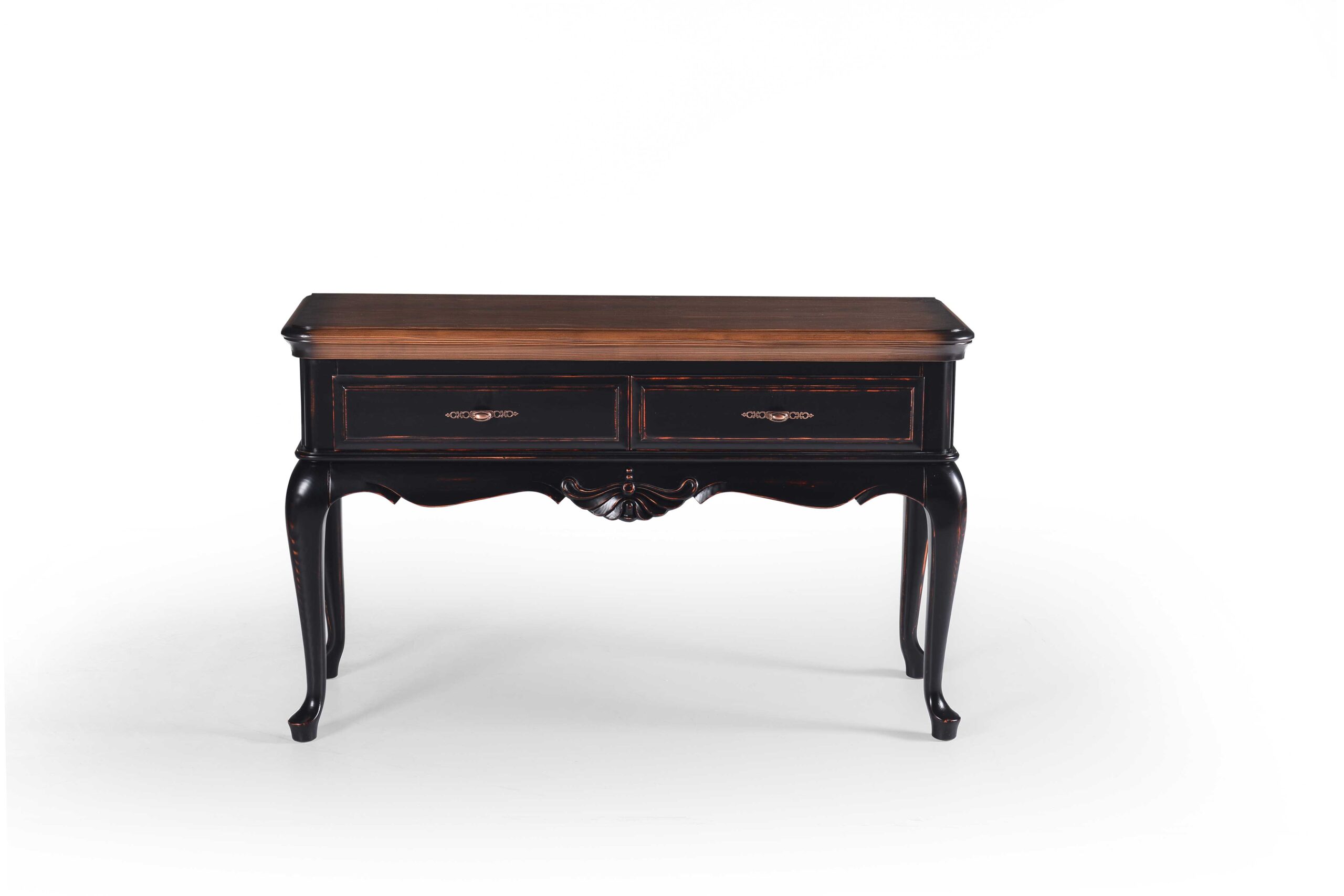
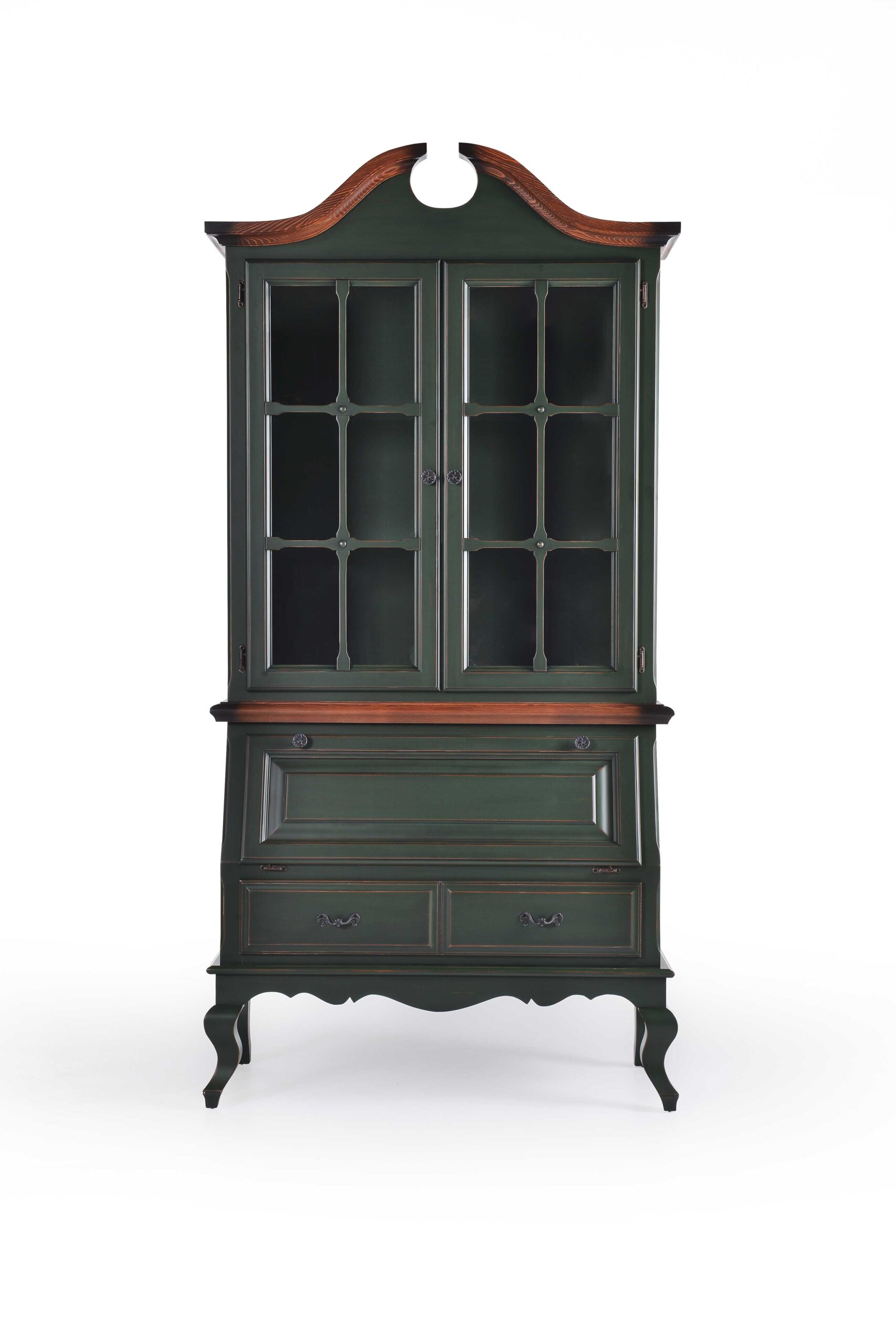
In İmhotep's product descriptions, two products spell out section by section where MDF is used: the Lükens Entryway Console and the Academy Bookcase. In both, the top or crown is spruce; MDF is used for the drawers and sides of the Lükens Entryway Console and, on the Academy Bookcase, for every section other than the crown and middle shelf. The product pages put it this way:
| Product | Sections listed with a wood species | Sections listed as MDF |
|---|---|---|
| Lükens Entryway Console | Top: spruce · Legs: hornbeam | Drawers and sides |
| Academy Bookcase | Crown and middle shelf: spruce | Other sections |
For these spruce and hornbeam sections, the descriptions use the phrase "first-grade kiln-dried"; kiln-dried means lumber whose moisture has been brought down in a drying kiln.
In the photos, the top or crown of both products appears in a walnut tone. The sections listed as MDF are painted an opaque color: black drawers and sides on the Lükens Entryway Console, a dark green patina carcass on the Academy Bookcase. On the Lükens Entryway Console, the hornbeam legs and the MDF drawers show the same black paint, so you have to learn the material from the written description, not from the picture. The descriptions do not say why each section is made of that material.
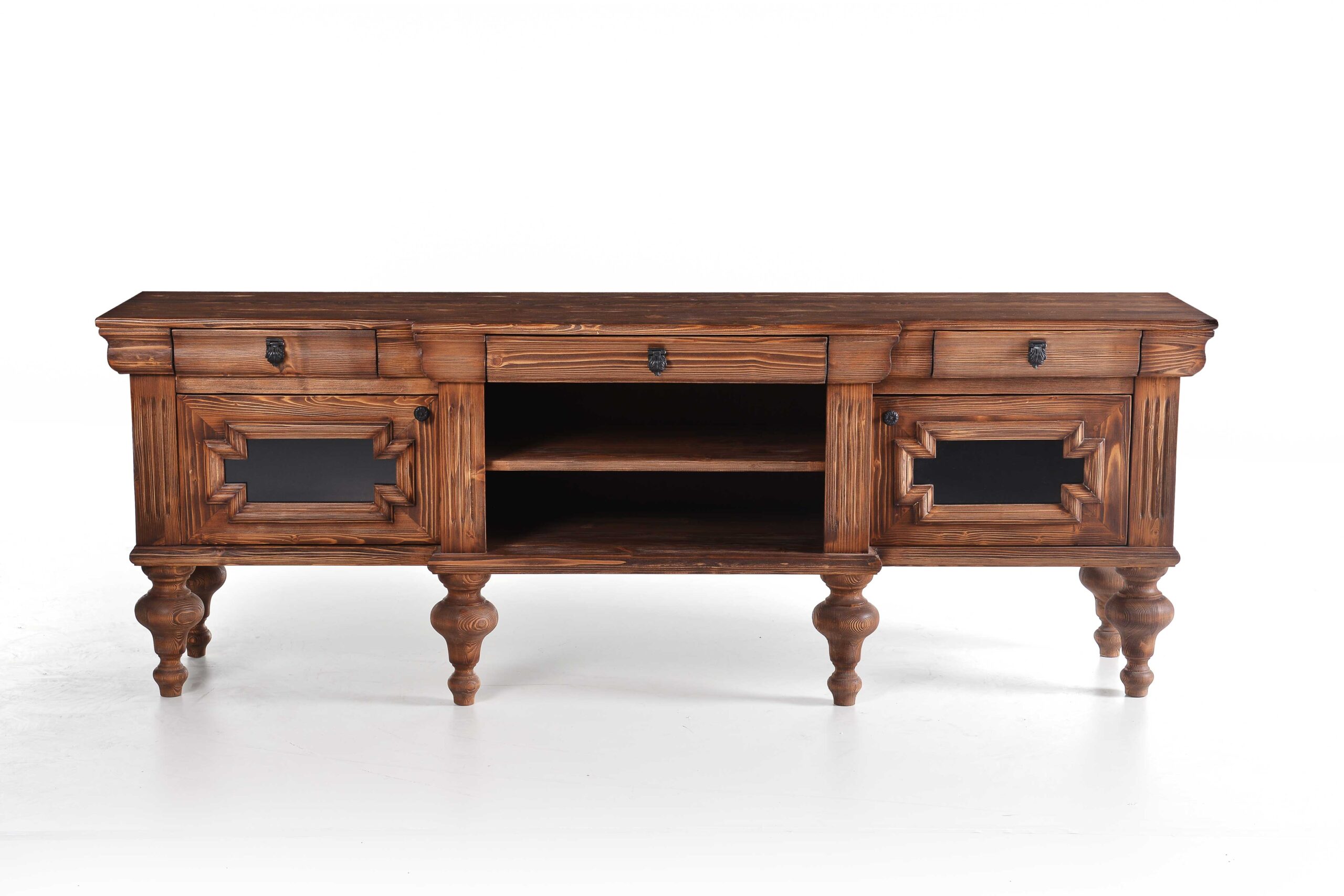
There is another approach as well. The description of the Prada TV Stand includes the phrase "a solid structure made entirely of first-grade kiln-dried spruce." With turned legs and a wire-brushed top (the surface is brushed with a wire brush to bring out the grain), this stand is an example made, according to its description, entirely of spruce. It measures 197 cm wide, 71 cm high, and 48 cm deep; we explain whether that height suits your seating in our article on TV unit dimensions.
Ask the seller for a written, part-by-part materials statement
The safest way to settle MDF or solid wood when you buy is to ask the seller to put the material of every part in writing. These five questions give you a sound framework:
- What are the top, legs, and supports made of; if solid wood, which species?
- Are the carcass sides, doors, and drawer fronts MDF, solid wood, or veneer?
- What are the drawer box and back panel made of?
- On the MDF parts, is the surface paint or veneer, and are the edges sealed?
- If the piece will stand where it may come into contact with water, are the MDF parts a moisture-resistant grade?
A general phrase such as "wood furniture" or "solid wood" is no substitute for these questions. If there is no written statement, look at the edge: the cut edge of MDF is grainless and uniform, while on solid wood the grain carries on around the edge; the inside of a drawer and the back panel often give clues too. The detailed checklist is in the solid wood furniture article.
MDF or solid wood? A quick summary
There is no single winner between MDF and solid wood; the decision is made separately according to the job each part does. In practice, look at these:
- Solid wood comes out ahead in parts such as tops, legs, and supports that carry load, get touched often, and may need refinishing later.
- MDF works on flat, painted panels; it should be protected from contact with water.
- Using both materials in the same piece is not a flaw in itself; which part is made of which material should be stated clearly.
İmhotep has been making solid wood furniture since 2002. At our 2,000 m² showroom in Siteler (Karacakaya Cad. No:141/A), you can see the products up close or ask through our contact page which section is made of which material. The showroom is open 08:00–19:00 on weekdays and 09:00–18:00 on Saturdays.
Frequently asked questions
Which is better, solid wood or MDF?
The same answer does not apply to every part. Solid wood has the advantage in parts such as tops, legs, and supports that carry load, see heavy use, and may need sanding and refinishing later. On wide, flat, painted side panels or doors, MDF does the job with its smooth surface and dimensional stability. The choice should follow the job the part does.
Is MDF water-resistant?
Standard MDF is not water-resistant; when water gets in, especially through the edges and screw holes, it swells, and the swelling is usually permanent. Moisture-resistant grades of MDF hold up better but are not waterproof. Sealing every face and edge with paint or veneer improves protection; spills should still be wiped up right away.
Is it bad for a piece of furniture to use both MDF and solid wood?
Not in itself; many makers use both materials in the same product. For example, the top and legs may be solid wood and the painted side panels MDF; that is using each material where it is strong. What matters is that you are told clearly which part is made of which material, and that you weigh that against where the piece will be used.
Can solid wood furniture be repaired?
Yes; that is one of the clearest advantages of solid wood. Scratches, dents, and stains can be removed by sanding and repainting or refinishing, and stripped screw holes can be made solid again with a wood dowel or plug. Because the material is wood all the way through, the surface can be renewed more than once. For deep damage, it is best to consult a craftsman.
Are MDF and particleboard the same thing?
No; both are panels made from wood, but their structure differs. MDF is made by pressing fine wood fibers with glue, particleboard by pressing coarser chips. MDF has a more uniform face and edge, so it is better suited to routing profiles and to painting. The chips show in the cut edge of particleboard, which is usually used with its face covered.