
TV Unit Dimensions: Choosing the Right Height, Depth and Width
Width based on the screen, height based on eye level, depth based on your devices: the measurements to check when choosing a TV unit, with low-stand and tall-unit examples.
TV unit dimensions depend on the screen, your eye level and your devices. The unit should be clearly wider than the screen; the common recommendation is to leave at least 10–15 cm on each side. Low TV stands are usually 40–70 cm tall, and the right height is the one that puts the center of the screen at or slightly below the seated viewer's eye level. Depth must accommodate the TV stand base and your devices; ready-made models are typically 30–50 cm deep.
Standard TV unit dimensions: low TV stand or tall unit?
There is no single standard TV unit size: most manufacturers make low TV stands 40–70 cm tall and 30–50 cm deep, while shelved units that cover the wall are much taller, and the two examples in this article are 200 cm. A TV unit is a living room piece that holds the television and offers storage or display space around it. On a low TV stand, the screen sits directly on top of a single cabinet. A tall unit adds an upper or side section with shelves and cabinets to that base; the screen goes in the open space left between or beside those sections.
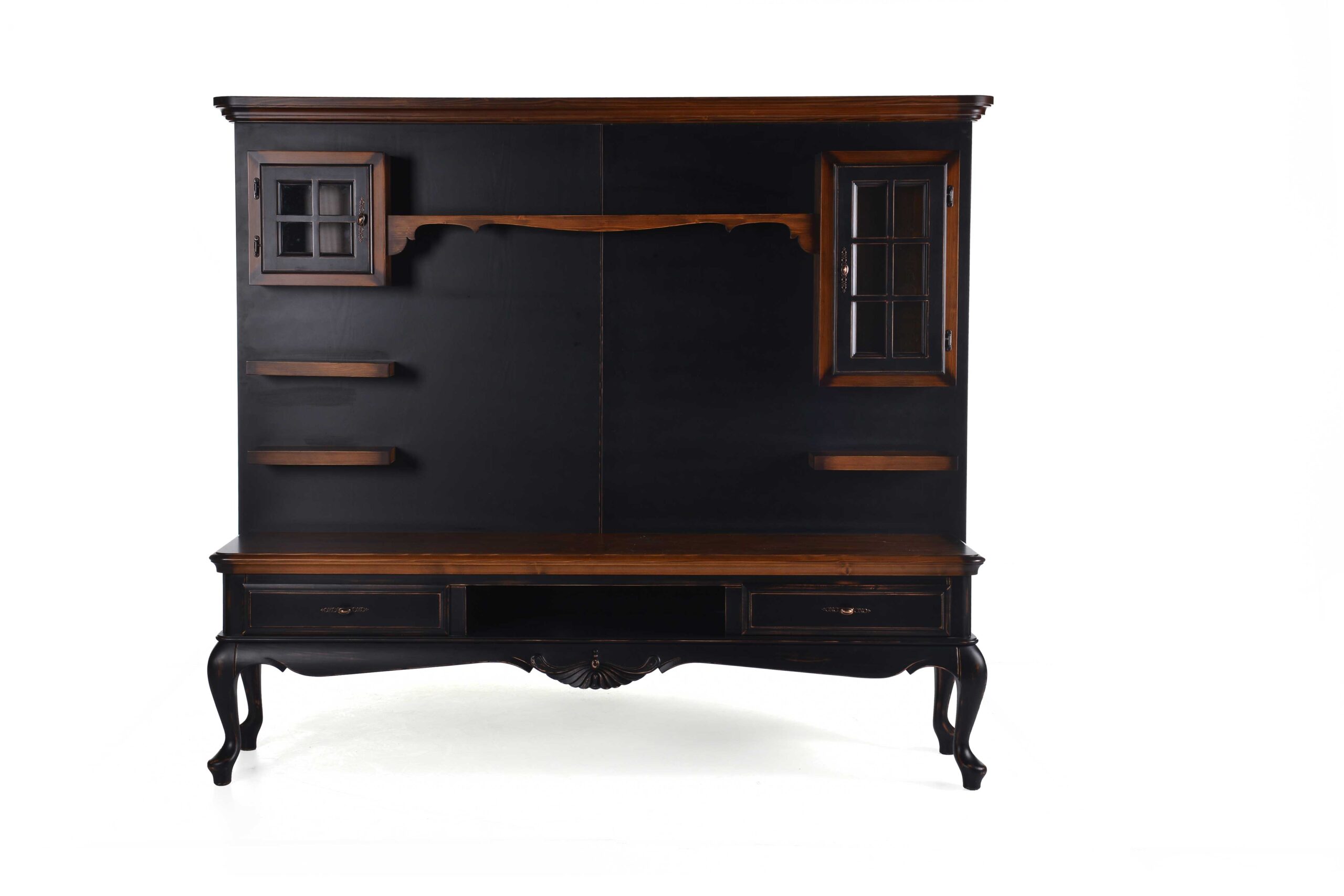
According to the dimensions on İmhotep's product pages, the Venedik and Lükens TV units in the table reach 200 cm in height, while the TV stands in the table range from 60 to 71 cm:
| Model | Type | Width | Depth | Height |
|---|---|---|---|---|
| Venedik TV Unit | Tall unit | 230 cm | 47 cm | 200 cm |
| Lükens TV Unit | Tall unit | 217 cm | 50 cm | 200 cm |
| Elvin TV Stand | Low TV stand | 210 cm | 47 cm | 61 cm |
| Prada TV Stand | Low TV stand | 197 cm | 48 cm | 71 cm |
| Elegance TV Stand | Low TV stand | 170 cm | 45 cm | 67 cm |
| Arizona TV Stand | Low TV stand | 170 cm | 50 cm | 60 cm |
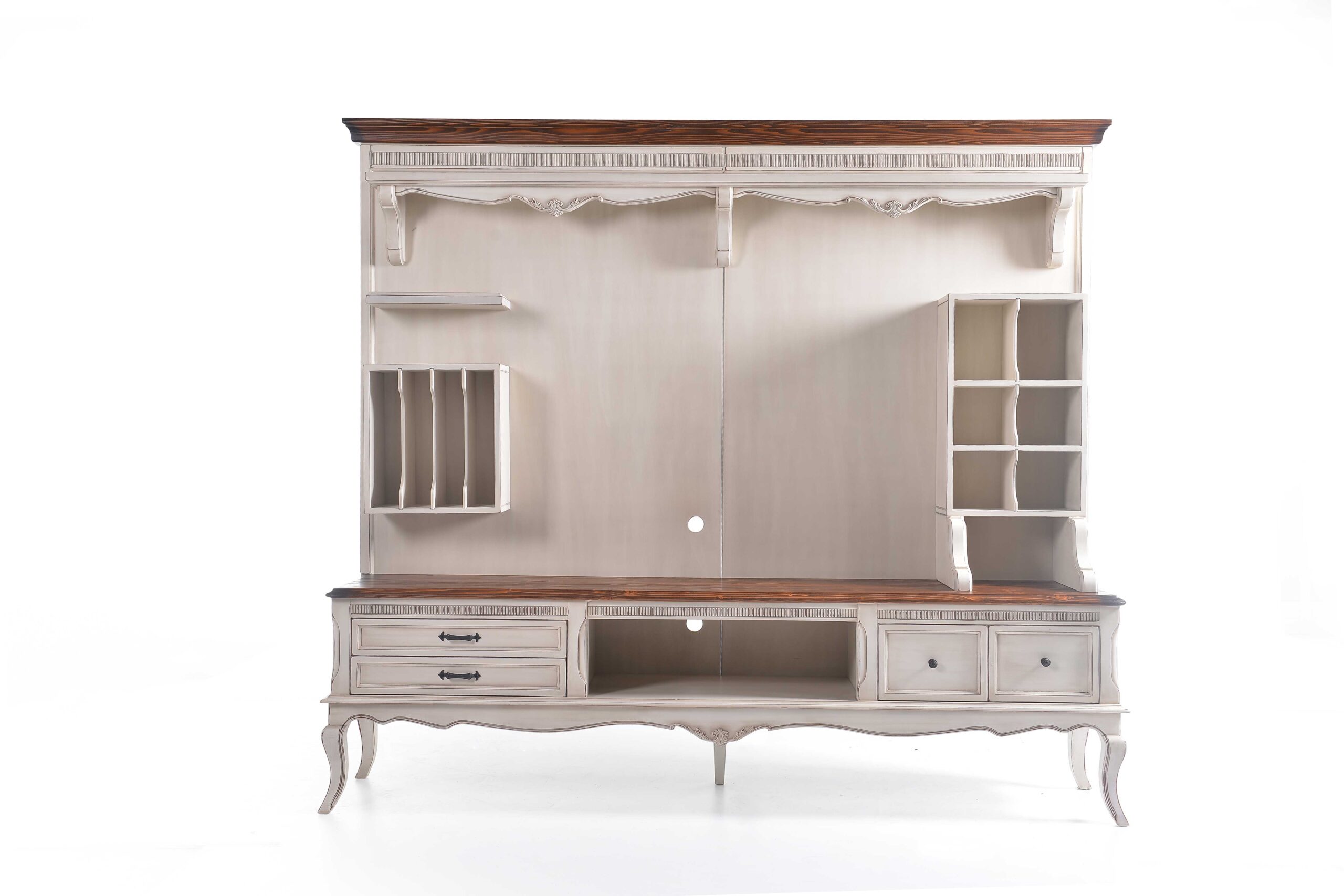
A tall unit organizes a blank wall with a single piece of furniture and can reduce the need for a separate bookcase; measure the ceiling, windows and outlets beforehand. The Venedik TV Unit is an example of this type: its storage, made up of drawers, open shelves and cubbies, is spread around the screen. A low TV stand, on the other hand, leaves the wall free and makes the room feel lighter.
The Novel TV Unit is not in the table because its product page lists no fixed dimensions; it can be adapted to the space with different size and color options. For walls that don't fit standard sizes, that is one solution.
TV unit width: matching the screen, the wall and the sofa
The unit should be wide enough to leave at least 10–15 cm of clearance on each side of the screen; to check this, first convert the screen's size in inches to centimeters. The inch figure is the screen's diagonal, but what matters for TV unit sizing is the screen's actual width. Approximate viewing-area dimensions for 16:9 screens:
| Screen | Viewing-area width | Viewing-area height | Minimum unit width |
|---|---|---|---|
| 43 in | 95 cm | 54 cm | 115–125 cm |
| 50 in | 111 cm | 62 cm | 131–141 cm |
| 55 in | 122 cm | 68 cm | 142–152 cm |
| 65 in | 144 cm | 81 cm | 164–174 cm |
| 75 in | 166 cm | 93 cm | 186–196 cm |
| 85 in | 188 cm | 106 cm | 208–218 cm |
The bezel adds a little to this width; get the exact width and the distance between the feet from the TV's spec sheet. On screens with feet at the edges, the feet must stay within the top surface.
Looking at width alone, the 170 cm Elegance and Arizona TV stands leave this margin for screens up to 65 inches, the 197 cm Prada for up to 75 inches, and the 210 cm Elvin, just barely, for up to 85 inches; check the foot spacing and the TV's weight separately. With tall units, what counts is not the overall width but the width and height of the open section where the screen will sit. Side shelves and small cabinets make that section noticeably narrower than the overall width; ask for these measurements before you order.

The wall and the sofa affect width too: a unit that covers part of the wall rather than all of it leaves breathing room on both sides, and a unit close to the width of the main sofa keeps the seating group balanced. For the distances between the sofa, coffee table and unit, see our coffee table dimensions guide.
TV unit height: the eye-level rule and a sample calculation
For a low TV stand, the right height is the one that keeps the center of the screen at or slightly below the seated viewer's eye level; most manufacturers make these stands 40–70 cm tall. The İmhotep TV stands in this article range from 60 cm (Arizona) to 71 cm (Prada TV Stand).
The eye level of an adult sitting on a sofa varies with the seat and the person's height, but it is generally about 100–115 cm off the floor. To find the center of the screen, add three numbers: the stand's height, the distance the TV's base lifts the screen above the top, and half the screen's height.
An example: the viewing area of a 55-inch screen is about 68 cm tall. A TV whose base lifts the screen 7 cm above the top, placed on the 60 cm Arizona TV Stand, puts the center of the screen about 101 cm off the floor (60 + 7 + 34). On the 71 cm Prada TV Stand, the same screen rises to about 112 cm. The first may be more comfortable with a low, deep sofa, the second with an upright seat.
If the TV will be wall-mounted, the eye-level rule still sets the screen's position, while your storage needs set the unit's height. On tall units, the overall height of 200 cm doesn't indicate where the screen goes; it shows how high the shelves and the top finish reach, which on the Venedik and Lükens means the crown (the molded cap on top of the unit). Do the eye-level calculation with the height of the surface the screen will sit on, and compare the overall height with your ceiling.
In a small room, you can also set the TV on a console instead of a separate unit; however, consoles are usually taller than TV stands, and the center of the screen may end up above eye level. The console must also be deep enough for the TV's base, and the TV should be anchored to the wall to prevent tipping. You can find other uses for a console in the living room in our what is a console for article.
TV unit depth: room for the TV base, devices and cables
A TV unit's depth must be enough for the TV's base to sit fully on the top and for your devices to fit; ready-made models are typically 30–50 cm deep, and 40 cm or more is more comfortable if devices will sit inside. The İmhotep models in the table range from 45 to 50 cm; the deepest, at 50 cm, are the Lükens TV Unit and the Arizona TV Stand.
- TV base: The top should be slightly deeper than the base depth listed on the spec sheet so the screen doesn't overhang.
- Devices: Measure the depth of your satellite receiver, modem or game console. A compartment's interior depth is somewhat less than the unit's exterior measurement.
- Cable clearance: Leave a small gap behind each device so power and HDMI cables can bend at the back.
- Ventilation: Devices that heat up need space around them; for an enclosed compartment, check the clearances in the user manual.
In a narrow living room, a shallow unit frees up walking space; the shallowest model in the table is the Elegance TV Stand at 45 cm. Anchor tall units, and stands that hold a large screen, to the wall to prevent tipping.
What is a TV unit made of?
A TV unit is made of solid wood, of panels such as MDF (often with a wood-veneer surface), or of a combination of these; the choice depends on which parts bear the load and the surface you want. The İmhotep examples in this article:
- The Prada TV Stand is made entirely of premium kiln-dried spruce; the Elvin TV Stand is also made of premium kiln-dried spruce.
- On the Venedik TV Unit, the top, crown and load-bearing uprights are solid wood.
- On the Elegance TV Stand, the top is spruce, and the legs and uprights are hornbeam.
- The Lükens TV Unit has legs of premium kiln-dried hornbeam; its top is described in the product information as “masif kaplama” (solid wood veneer).
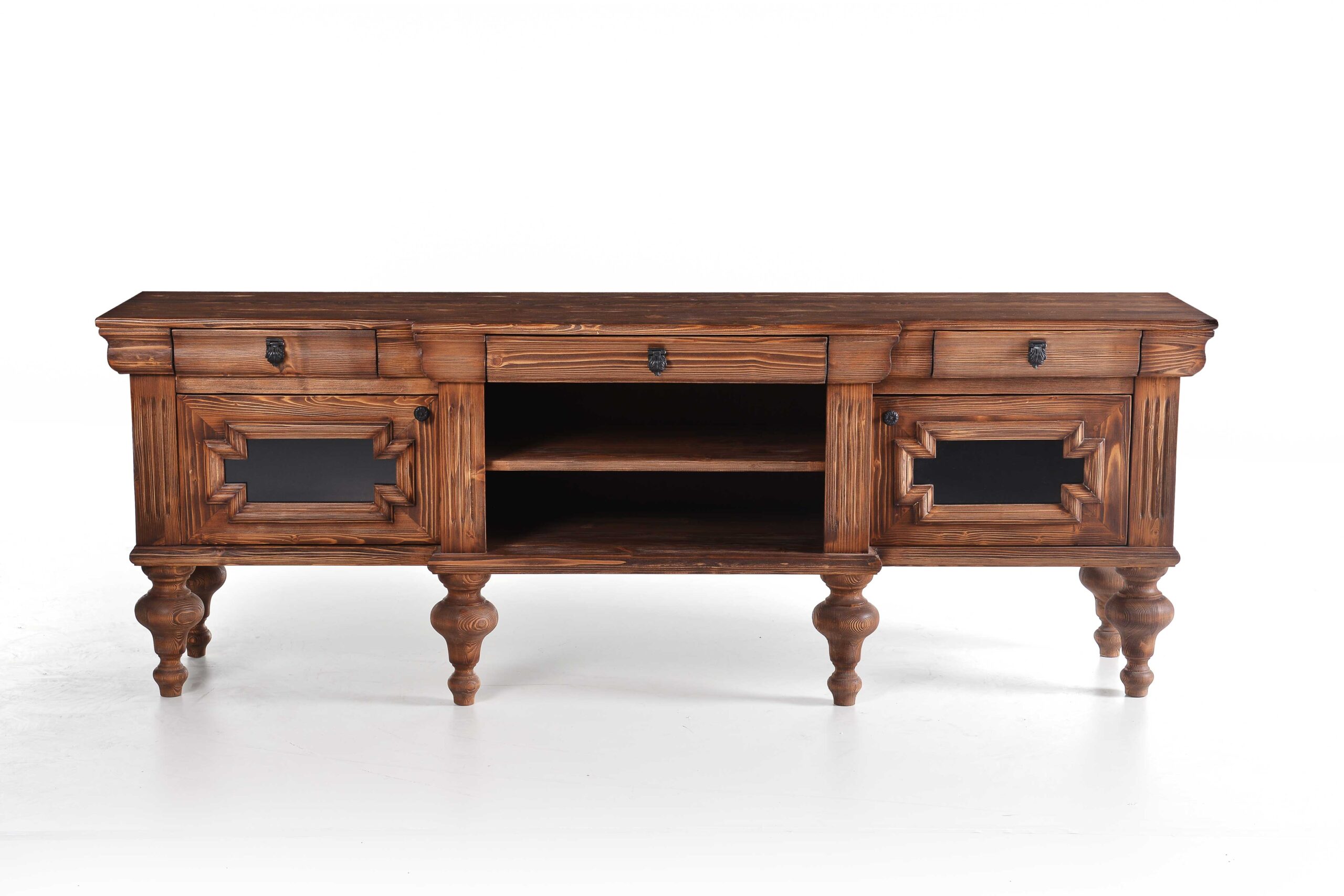
There are three storage options: doors keep out dust and hide clutter, drawers are for remotes and small items, and open shelves suit devices and decorative objects. Soft-close slides are drawer runners that slow the drawer as it closes so it settles quietly into place; among the models in the table, they are used in the drawers of the Prada, Elegance and Arizona TV stands and the Venedik and Lükens TV units. The Elvin TV Stand, for its part, has doors with molding strips and glass details.
Living room TV unit decor
The basic rule of living room TV unit decor is to keep the area around the screen simple but balanced. This is easy with tall shelved units: you can use the open shelves of the Venedik and Lükens TV units for books and objects, and their drawers for things you'd rather keep out of sight.
- Alternate books, objects and empty space on the shelves; filling every shelf makes the unit look cluttered.
- With a low TV stand, symmetrical frames hung on either side of the screen tie the stand and screen together.
- Consider the unit's wood tone together with your sofa set. Each model in this article is offered as a complementary piece of a sofa set; for example, the Elvin TV Stand is part of the Elvin Sofa Set.
In short: a checklist for ideal TV unit dimensions
There is no single standard answer to what a TV unit should look like; ideal TV unit dimensions emerge when you read the TV's spec sheet, the wall measurements and your seated eye level together. Before choosing a unit, note down:
- The net width of the wall and the position of window and door edges.
- If you're considering a tall unit, the ceiling height and a wall surface you can anchor the unit to.
- The location of power outlets, antenna and internet jacks.
- The screen's width, height and the distance between its feet.
- The base depth and the dimensions of the devices that will sit in the unit.
- Your eye level from the floor when seated on the sofa.
All six models in the first table are listed together in the TV stand category. If you'd like to see the wood tones and craftsmanship in person, you can visit our showroom in Siteler, Ankara (Karacakaya Cad. No:141/A), weekdays 08:00–19:00 and Saturdays 09:00–18:00; you can call ahead at 0 312 351 03 32 to ask which models are on display.
Frequently asked questions
How big should a TV unit be?
The width should leave 10–15 cm of clearance on each side of the screen; for a 55-inch screen, that comes to about 142–152 cm. Low TV stands are generally 40–70 cm tall and 30–50 cm deep. For shelved units, choose the overall height based on the ceiling; the two examples here are 200 cm tall and 47–50 cm deep.
How tall should a TV unit be?
For a low TV stand, 40–70 cm usually works. The right value is the height that brings the center of the screen to, or slightly below, the eye level of someone seated on the sofa. The lower end is more comfortable with low, deep sofas, the upper end with upright seats.
How deep should a TV unit be?
Ready-made models are typically 30–50 cm deep; if devices will sit inside, 40 cm or more is more comfortable. The top should be slightly deeper than the TV's base, and you should add a small allowance for cables to each device's depth. The İmhotep models in this article are 45 to 50 cm deep.
How wide should a TV unit be?
Adding 10–15 cm on each side of the screen's width is a common minimum. A 55-inch screen has a viewing area about 122 cm wide, so a unit of 142–152 cm or wider works well. On TVs with feet at the edges, the feet should stay within the top surface.
How high off the floor should a TV unit be?
The top should be high enough to bring the center of the screen to about 100–115 cm off the floor, at or slightly below the seated viewer's eye level; for low TV stands, that usually means 40–70 cm. To calculate it, add the stand's height, the height of the screen's bottom edge above the top, and half the screen's height. With a wall-mounted screen, compare the result with your eye level as well.
How do you decorate a TV unit?
Keeping the area around the screen simple but balanced is the safest approach. On shelved units, alternate books, objects and empty space; don't fill every shelf. Above a low TV stand, symmetrical frames or a slim wall shelf are enough. Choose the wood tone together with your sofa set.