What Is Solid Wood Furniture and How Can You Tell? Panel vs. Veneer
What do solid wood, solid wood panel and solid wood veneer mean, and what does kiln-dried tell you? A step-by-step guide to checking whether a piece is solid wood before you buy.
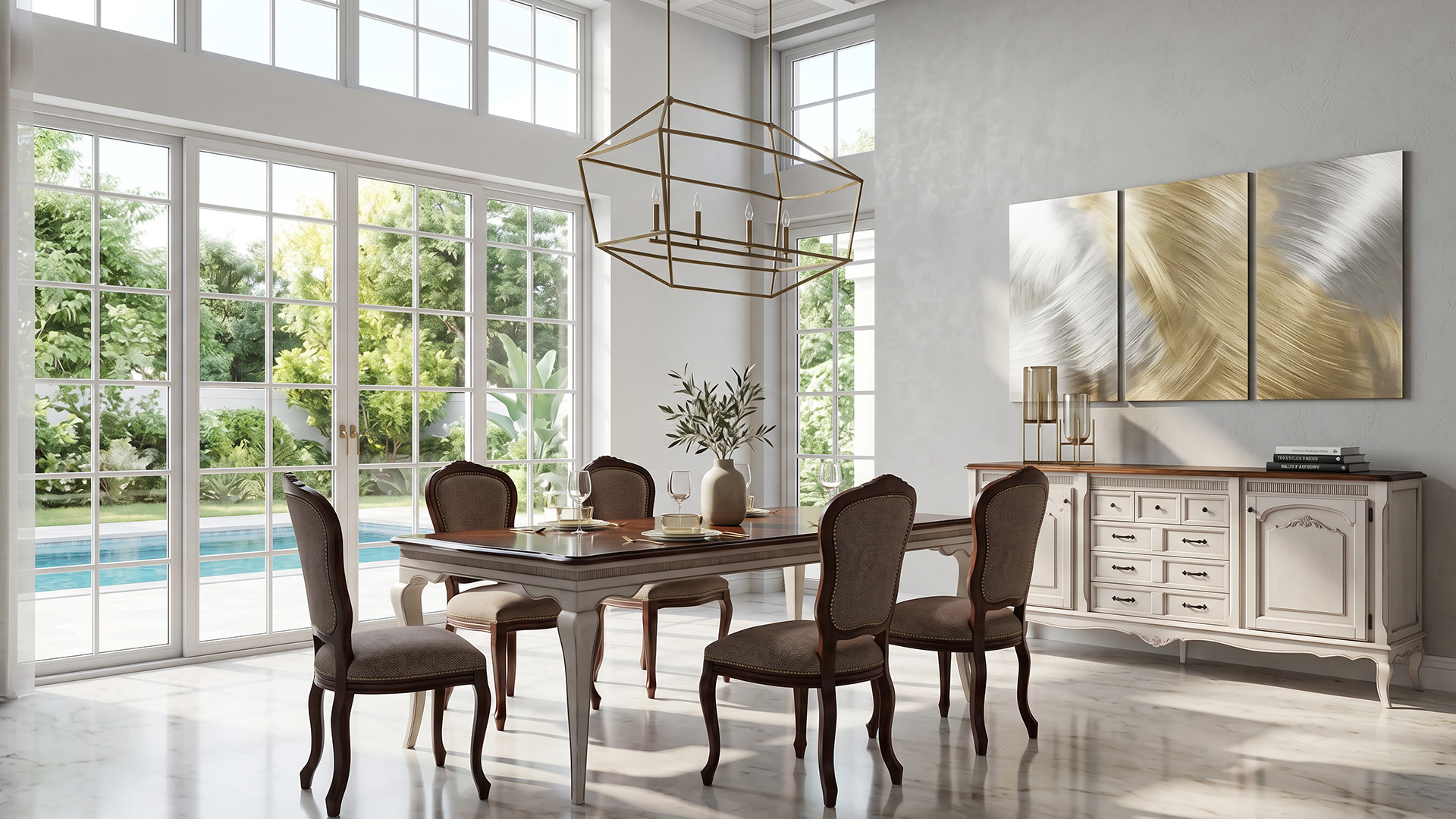
Solid wood furniture is made from natural lumber, cut and dried. A part may be a single board or solid wood strips glued side by side to widen it; either way, the cross-section is real wood throughout. MDF and particleboard panels, or parts with only a wood surface layer, don’t count as solid wood. You can tell by checking the edges, the drawer interiors and the written material specification.
What is solid wood furniture? Solid wood vs. solid wood panel vs. solid wood veneer
All three terms involve wood, but only the first two tell you the part is wood throughout. Solid wood is natural wood, in one piece or joined; a solid wood panel is a wide board made by gluing solid wood strips together; solid wood veneer usually means a layer of real wood applied to the surface of a substrate panel.
| Term | What it means | What you see at the edge and in the cross-section | Where you often see it |
|---|---|---|---|
| Solid wood | A part made from dried lumber, either in one piece or from several boards joined together | The grain wraps unbroken from the face onto the edge; the cross-section is the same wood throughout | Legs, arms, carved and turned work, frames, tabletops |
| Solid wood panel | A wide board made by gluing solid wood strips (lamellas) side by side, and sometimes end to end | The glue lines between strips show on the face and in the cross-section, sometimes with finger joints | Cabinet carcasses, shelves, doors, tops |
| Solid wood veneer | A wood surface glued onto a substrate panel | The surface is real wood; at the edge you may notice the veneer line or separate edge banding; if the edge is capped with a solid wood strip, the edge looks like wood too | Wide tops, doors, side panels |
In the trade, a solid wood panel may also be called “edge-glued” or “glued-up” solid wood; “solid wood panel furniture” usually means furniture whose carcass, shelves and doors are made from these panels. Because the word “laminate” is also used for melamine-faced particleboard, it can be misleading on its own when describing a solid wood panel. A wide tabletop is rarely cut in one piece from a single trunk; gluing several boards together along their edges is normal, and the part is still solid wood. MDF (medium-density fiberboard) and particleboard (chipboard), by contrast, are panels made by pressing wood fibers or chips together with glue; we compare which parts each one suits, and why, in our MDF vs. solid wood guide.
Solid wood veneer furniture: why it’s used and on which parts
Solid wood veneer is a layer of real wood glued onto a substrate panel that generally moves less with humidity; it’s used mostly on wide tops, doors and side panels. Solid wood expands and contracts slightly with the humidity of the room, especially across the grain, and on a wide top that movement is more noticeable. That’s why many makers prefer veneer for wide surfaces and solid wood for shaped parts such as legs, carvings and turned work.
Not all veneer is the same: the wood species and thickness of the veneer, the material underneath and how the edges are covered vary from maker to maker. When you see the phrase “solid wood veneer,” asking about these three points is a good start. A veneered surface also has a limit: because the layer is often thin, it may not take as deep a sanding and refinishing as a solid wood surface; how much refinishing it can take depends on the veneer’s thickness.
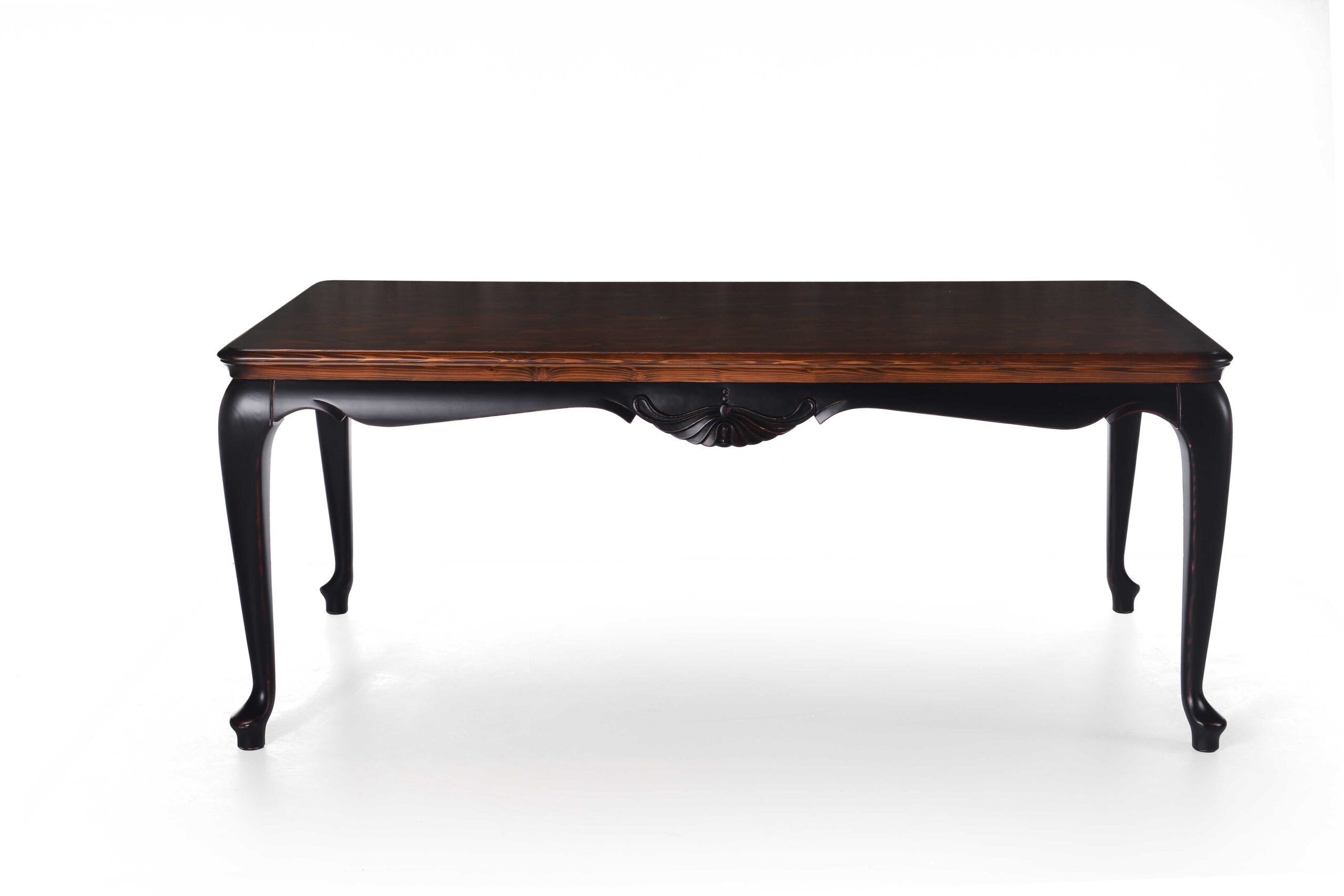
Some İmhotep product descriptions spell this distinction out. The description of the Lükens Dining Table says, “The top is solid wood veneer, and the legs are made of first-grade kiln-dried hornbeam.” The same description notes that the surface brings out the grain of spruce. The İmhotep Dining Table’s description likewise lists “solid wood veneer” for the top and hornbeam for the legs. The best approach is to ask, product by product, what construction this phrase describes (the thickness of the veneer and, if there is one, the material beneath it).
How to tell if furniture is solid wood: a checklist before you buy
The most reliable way to identify solid wood furniture is to look at several clues together rather than a single sign, and to ask for the materials part by part, in writing. Because veneer is real wood too, judging by the surface alone can mislead you. Before you buy, you can use this checklist:
- Check the edge and the end grain. On a solid wood top, the grain follows the same line as it turns from the face onto the edge, and the short end of the top (the end grain) usually shows growth rings. On a veneered part, you may see a thin layer line at the edge, separate edge banding or a pattern that doesn’t match the face. Don’t rely on the edge alone: many makers cap the edge of a veneered top with a solid wood strip, so you also need to check the underside, the inside of the drawers and the written specification.
- Check the hidden areas. Drawer interiors, drawer bottoms, the back panel and the underside are where the material shows most clearly. Many makers use a different panel for the back or the drawer bottoms of a cabinet with a solid wood front; that’s not a flaw, just a detail worth knowing.
- Look for a repeating pattern. On printed wood-look surfaces, the pattern often repeats exactly, in the same direction and at regular intervals. In solid wood, no two parts are identical; in real wood veneer, however, leaves cut from the same log can look very much alike, or sit in mirror-image symmetry in an arrangement called book-matching. That symmetry is not a sign of a print.
- Don’t rely on weight alone. MDF is a dense, heavy panel, while a solid wood piece made from a relatively light wood such as spruce may feel lighter than you expect.
- Get the material of each part in writing. Instead of accepting a general phrase like “solid wood,” ask in writing which material is used for the top, legs, carcass, doors, drawers and back, one by one.
- Inspect the piece up close. A photo doesn’t show the grain, the edges or the inside of the drawers. If you can, examine the piece in a showroom, opening the drawers and looking at the edges.
What is kiln-dried wood, and what does kiln drying do?
Kiln-dried wood is lumber that has been dried in a kiln after cutting, with its temperature and humidity kept under control. “Kiln-dried solid wood” likewise means solid lumber that has been dried in a kiln. Freshly cut wood holds a lot of water. If that water isn’t removed before the wood is worked, the wood keeps drying after it becomes furniture, which raises the risk of cracking, warping and joints opening up.
Wood is also air-dried outdoors, but that depends on the weather, takes longer and often can’t bring the wood’s moisture down to the level of a centrally heated interior; that’s why furniture lumber is usually kiln-dried. The goal of kiln drying is to bring the wood’s moisture close to the conditions of the interior where it will be used. Drying reduces this risk but doesn’t eliminate it: even after drying, wood keeps taking on and giving off moisture with the humidity around it; in other words, it “moves.” So even a carefully dried piece may move slightly as the seasons change.
“Kiln-dried wood” is sometimes confused with thermally modified wood. Thermally modified wood is a material whose structure has been altered with high heat and is used mostly outdoors; “kiln-dried” in furniture descriptions refers to the drying process.
Many İmhotep product descriptions use the phrase “first-grade kiln-dried,” mostly for spruce or hornbeam parts. In the lumber trade, “first grade” generally refers to lumber with few knots and cracks and a straight grain; the criteria can vary by supplier. If you want to know what standard “first grade” in a description is based on, or how the drying was done, it’s worth asking before you buy, whichever maker you buy from.
How to read a product description: top, legs, carcass
When reading a product description, first look at which material is listed for which part; the words “solid wood” on their own may not cover the whole piece. These are the part names you’ll see most often in descriptions:
- Top: The upper surface of a table or coffee table; it’s the widest and most visible part.
- Legs and apron: The legs that carry the top, and the rails that run around beneath the top and tie them together. Carved and turned work is mostly found here.
- Carcass: The box of a cabinet, chest of drawers, console or entryway console, made up of the sides, top, bottom and back.
- Frame or structure: In sofas, bergère armchairs and settees, the framework hidden beneath the upholstery; you can’t see it, but it determines how durable the piece is.
Three İmhotep products show how much the level of detail in descriptions can vary:
| Product | What the description says | What it tells you |
|---|---|---|
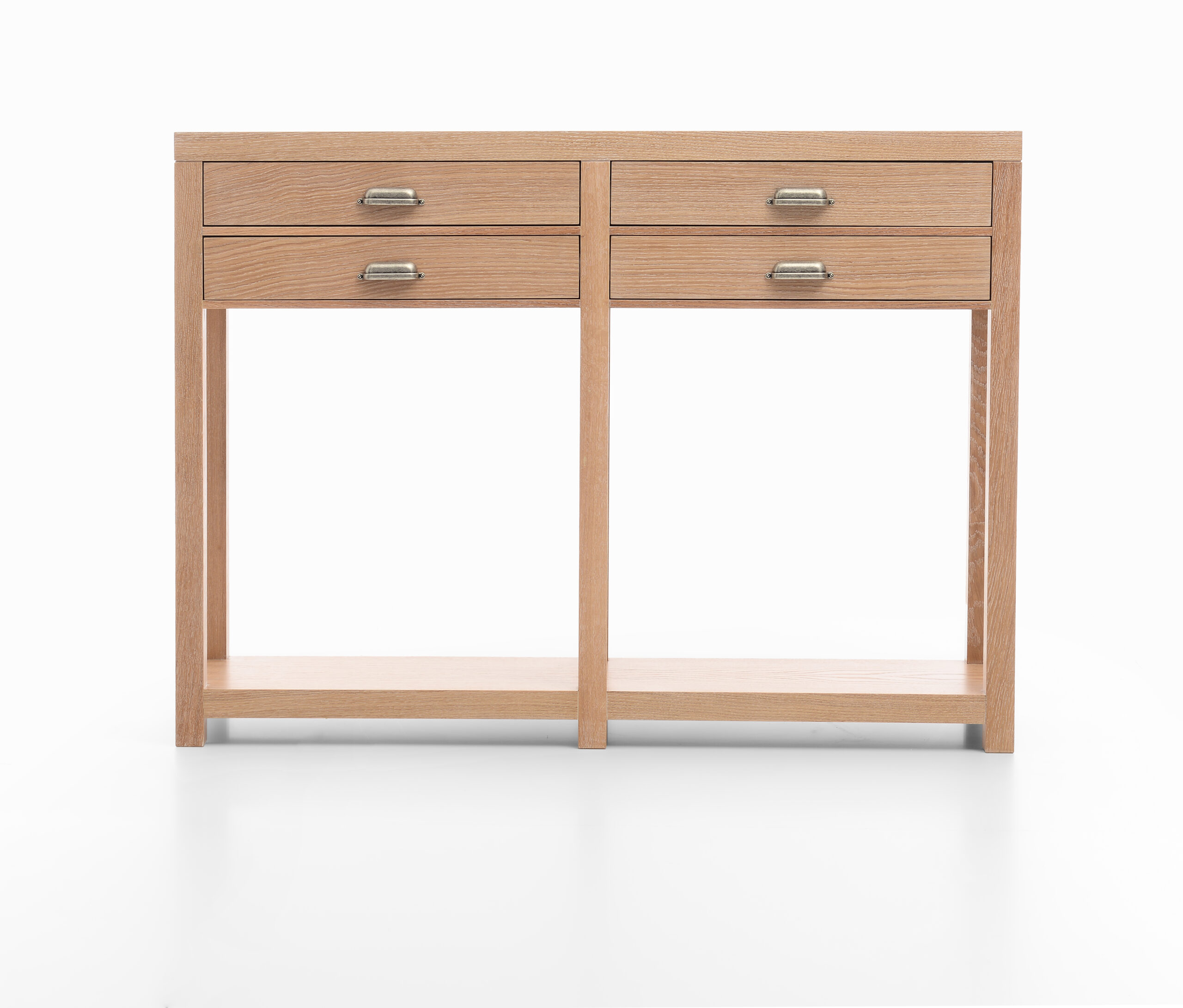
| Bodrum Entryway Console | “Made entirely of oak” | One wood species for the whole piece |
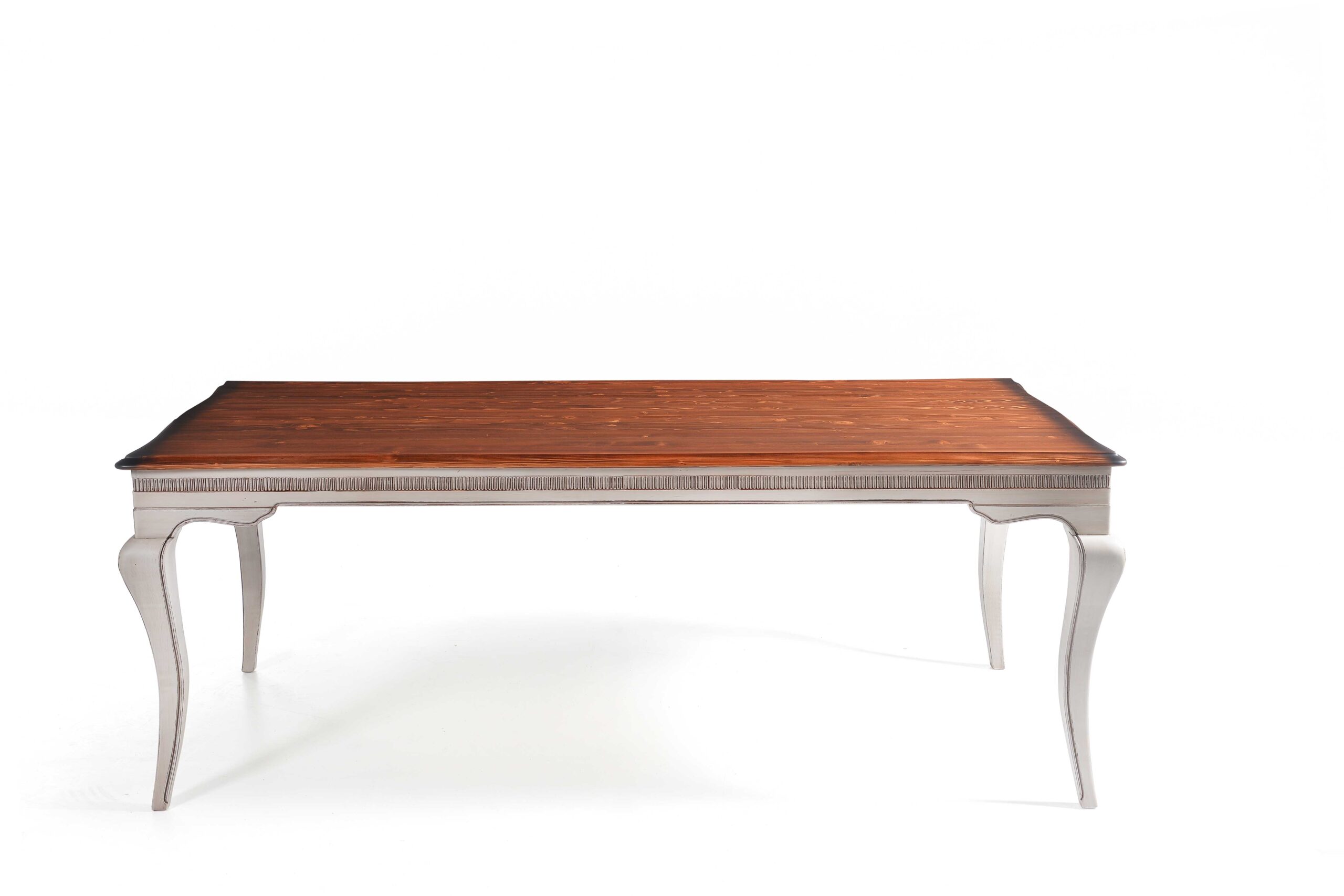
| Venedik Dining Table | Top in first-grade kiln-dried spruce, legs in first-grade kiln-dried hornbeam | A part-by-part statement, two wood species |
| Lükens Dining Table | Top in solid wood veneer, legs in first-grade kiln-dried hornbeam | Solid wood veneer on the top, hornbeam on the legs |
These differences aren’t about ranking the products; they matter for reading a description correctly. For Bodrum, the statement covers the whole piece. For Venedik, the top and legs are listed separately: spruce, a relatively soft wood with prominent grain, is used on the wide surface, and hornbeam, a hard, dense wood, on the legs. We look at which wood suits which part, and why, in a separate article on hornbeam, spruce, beech and oak. If a description doesn’t state the material of a part, such as the drawers or the back, you need to ask about it separately.
Pros and limitations of solid wood furniture
The biggest advantage of solid wood furniture is that it can be repaired and refinished; its most noticeable limitation is that it moves with humidity and heat. Both stem from the fact that it is natural wood.
Pros
- Repair: Scratches, dents and stains can be removed by sanding and then repainting or re-varnishing; because the material is wood throughout, this can be done more than once.
- Shaping: Hand carving and turned work generally call for solid wood; it’s also worth asking whether a carved-looking detail is hand-carved, machine-carved or a glued-on appliqué.
- Aging: The small marks and deepening color that come with use add character to the wood.
Painting and changing the color
The color of a solid wood surface can be changed once the old varnish or paint has been sanded off: a light tone can be darkened, or a patina or distressed finish applied. The Venedik Dining Table shows how differently patina can turn out on a single table: its spruce top has a dark walnut tone done with patina and accented with shading, while its hornbeam legs have a cream distressed patina. At İmhotep we use water-based paints, which contain fewer volatile organic compounds than solvent-based ones. We explain the technique in our guide to patina finishes.
Limitations
- Humidity and heat: In the dry heating season, fine gaps may appear at the joints; in humid periods, doors and drawers may stick slightly. Keeping furniture away from radiators and stoves reduces this movement.
- Sunlight: Over time, direct sunlight changes the color of the wood and the paint.
- Weight: Solid pieces made from hard, dense woods such as oak and hornbeam are heavy and need more care when they’re moved and set in place.
- Surface sensitivity: On soft woods such as spruce, hard knocks can leave marks; these marks can be repaired but can’t be fully prevented.
- Natural variation: Grain, color and knots are never exactly the same in two pieces; small differences between the product in the photo and the one that reaches you are natural.
With regular care (cleaning, protection from humidity and heat, and renewing the finish when needed), you can reduce the effect of most of these limitations; you’ll find the details in our wood furniture care guide.
In short: what to look for when buying solid wood furniture
When choosing solid wood furniture, the real task is knowing the material of each part. Here’s what to keep in mind:
- Solid wood and solid wood panels are wood all the way through; with solid wood veneer, the real wood is on the surface.
- The end grain, underside, drawer interiors and back tell you more about the material than the surface does.
- “Kiln-dried” means controlled drying; it reduces wood movement but doesn’t stop it.
- Ask separately about the material of any part the description doesn’t mention.
We at İmhotep specialize in solid wood furniture: founded in 2002, our company now manufactures in 3,500 m² of indoor production space. At our showroom in Siteler, Ankara (Karacakaya Cad. No:141/A), you can examine the pieces up close and ask about the materials part by part; if you have questions before you visit, you can send them through our contact page. The showroom is open weekdays from 8:00 a.m. to 7:00 p.m. and Saturdays from 9:00 a.m. to 6:00 p.m.
Frequently asked questions
What does solid wood furniture mean?
It’s furniture made from natural wood, that is, from lumber that has been cut and dried. A part can be made from a single board or from solid wood strips joined together; what matters is that the cross-section is real wood all the way through. Panels such as MDF and particleboard fall outside this definition, as do parts that only have a wood layer on the surface.
Does solid wood veneer count as solid wood?
It depends on the construction. “Solid wood veneer” isn’t used in just one sense in the trade: it generally means a layer of real wood over a substrate panel, but the layer’s thickness and the material beneath vary from maker to maker. That doesn’t make veneer a poor choice; it’s widely used on wide tops and doors. For a fair comparison, ask about the veneer’s wood species and thickness, the material underneath and how the edges are covered.
How can you tell if furniture is solid wood?
By weighing several clues together rather than a single sign. Look for growth rings in the end grain, check whether the grain runs unbroken from the face onto the edge, and look inside the drawers, at the back and underneath; a pattern that repeats exactly suggests a printed surface. Weight alone isn’t enough. The surest approach is to ask for the material of the top, legs, carcass and doors in writing and to inspect the piece up close.
Can solid wood furniture be painted?
Yes. Once the existing varnish or paint has been sanded off, solid wood can be repainted, darkened, or given a patina or distressed finish. Because the material is wood throughout, this can be done more than once. On veneered surfaces, though, the layer may be thin, so it’s best to sand carefully and, if needed, consult an experienced finisher.
What is kiln-dried wood?
It’s wood that has been dried in a kiln under controlled temperature and humidity, and it’s what furniture descriptions mean by “kiln-dried.” The aim is to bring the wood’s moisture close to the conditions of the interior where it will be used, reducing the risk of cracking and warping later. It isn’t the same as thermally modified wood, which has its structure altered by high heat and is mostly used outdoors.
What are the disadvantages of solid wood furniture?
Mainly, it moves with humidity and heat, pieces in hard woods such as oak and hornbeam are heavy, and it needs regular care. Between dry and humid seasons, fine gaps may open at joints or doors may stick slightly; direct sunlight changes the color. On soft woods such as spruce, knocks can leave marks. With the right placement and regular care, most of these limitations stop being a problem, and marks can be repaired with sanding and paint.