Console, Entryway Console, Buffet or Display Cabinet?
A console, an entryway console, a buffet and a display cabinet aren’t the same piece of furniture. We compared which room each goes in, what it holds and how big it is, using real dimensions.
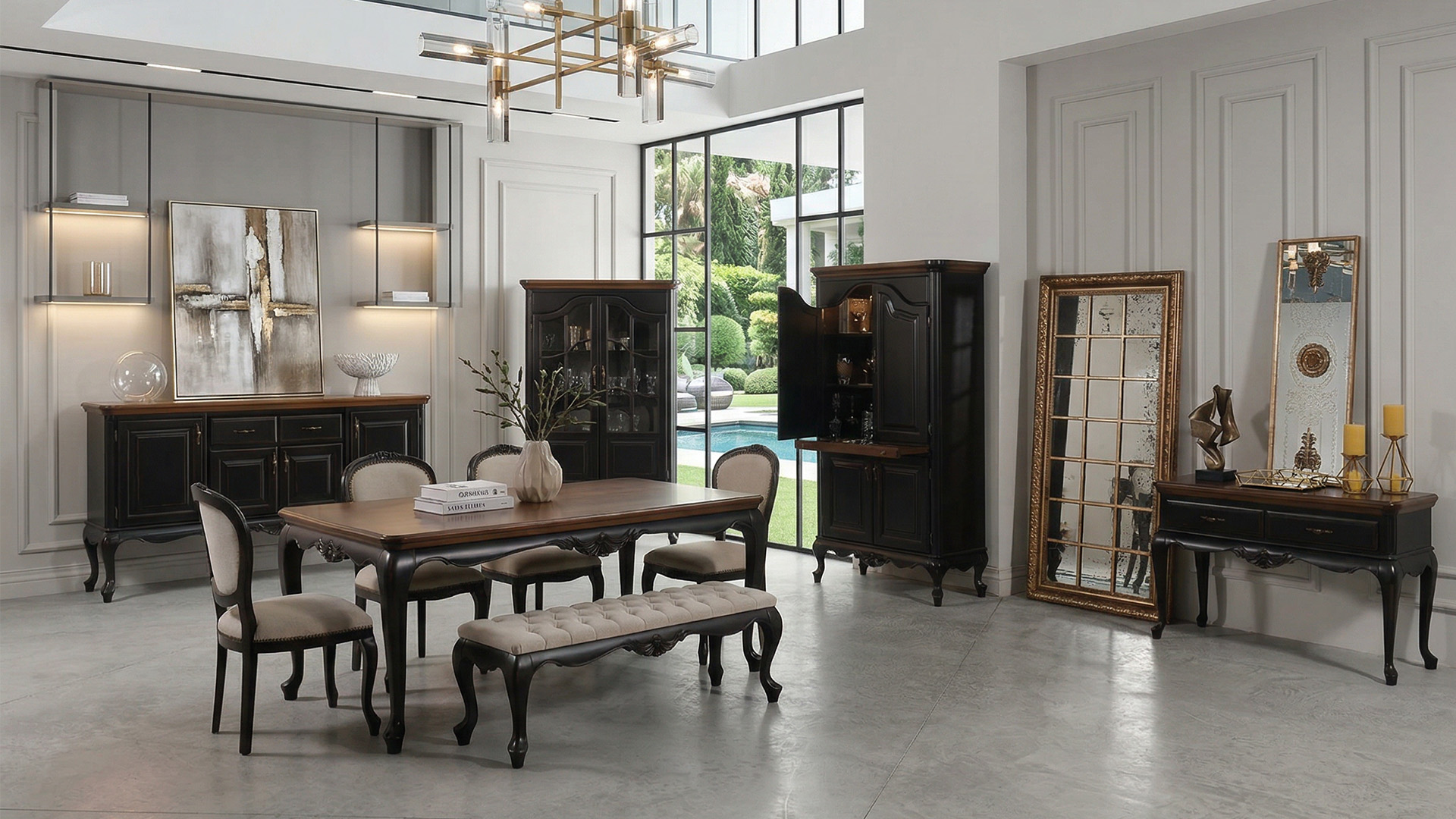
A console is used for storage and serving. In Turkey, it’s usually a long dining room cabinet set against a wall, with doors and, on many models, drawers. It stores plates, glassware, flatware and tablecloths; its top holds decor, plus dishes while you serve. An entryway console is shallower and made for entrances, a display cabinet shows pieces behind glass, and buffet is a general name for these cabinets.
What are consoles, entryway consoles, buffets and display cabinets? Quick definitions
The console, the entryway console and the display cabinet are three separate pieces of furniture that stand against a wall; buffet is a more general name used for both the console and the display cabinet. The three differ in the room they’re used in, how deep they are and what they hold.
- Console: The dining room’s wide cabinet with doors, and on many models drawers. It stores dinnerware, glassware and serving platters; on top sit a lamp, a few decorative objects and the dishes set down during serving. Each of the 16 consoles at İmhotep is part of a dining room set.
- Entryway console: A wall table or low cabinet used in an entryway, hallway or living room, and noticeably shallower than a console. It offers a few drawers or a lower shelf; its main job is to provide a surface for keys, mail, a lamp and decor.
- Buffet: In Turkish, “büfe” is a general name for a dining room cabinet. Sometimes it means the low cabinet with doors, sometimes the cabinet with a glass-fronted upper section; in furniture catalogs, these two pieces usually appear separately, as the console and the display cabinet.
- Display cabinet: A tall cabinet with glass doors on the front that both protects and shows off what’s inside. It’s used for porcelain, crystal and collectibles.
Part of the confusion comes from language. Outside Turkey, “console” usually means a narrow wall table: the piece Turks call a “dresuar” and this article calls an entryway console. Turkish also uses the word “konsol” now and then for the narrow, mirrored wall table by the entrance; in furniture stores, though, it mostly means the wide dining room cabinet. So when you shop, look at the dimensions more than the name.
Comparison table: console, entryway console and display cabinet sizes
The defining difference is depth and height: a console is wide and deep, an entryway console is narrow and shallow, and a display cabinet is a tall unit that reaches eye level and beyond. The ranges below were compiled from the dimensions on the product pages of İmhotep models; sizes are given as width × depth × height.
| Piece | Where it’s used | Width | Depth | Height | Storage |
|---|---|---|---|---|---|
| Console (16 models) | Dining room, living room | 195–255 cm | 49–60 cm | 70–118 cm | Ample: cabinet compartments with doors, drawers on many models |
| Entryway console (3 models with listed dimensions) | Entryway, hallway, living room, dining room | 130–140 cm | 35–44 cm | 80–95 cm | Limited: a few drawers or a shelf |
| Display cabinet (3 models) | Dining room, living room | 115–170 cm | 44–50 cm | 164–220 cm | Display: glass-fronted section |
| Bar cabinet (Lükens Bar) | Dining room | 105 cm | 46 cm | 197 cm | Serving: room for glasses and bottles, serving surface |
The dimensions in the table are the ones listed on the product pages. Of these models, the Novel Display Cabinet can also be made in the size and color you want.
What is a console used for? Its place and size in the dining room
A console keeps everything the dining table needs within reach: the inside is storage, and the top is a surface for serving and decor. The Şato Console’s product description also calls consoles one of the key elements of dining room decor.
In most cases, put the console on the wall facing the long side of the dining table. Between the table edge and the console, leave enough room to walk through comfortably even with a chair pulled back; most layouts keep this distance at 90 cm or more. If you’ll be serving from behind seated guests and the console doors open into that space, 100–120 cm is more comfortable.
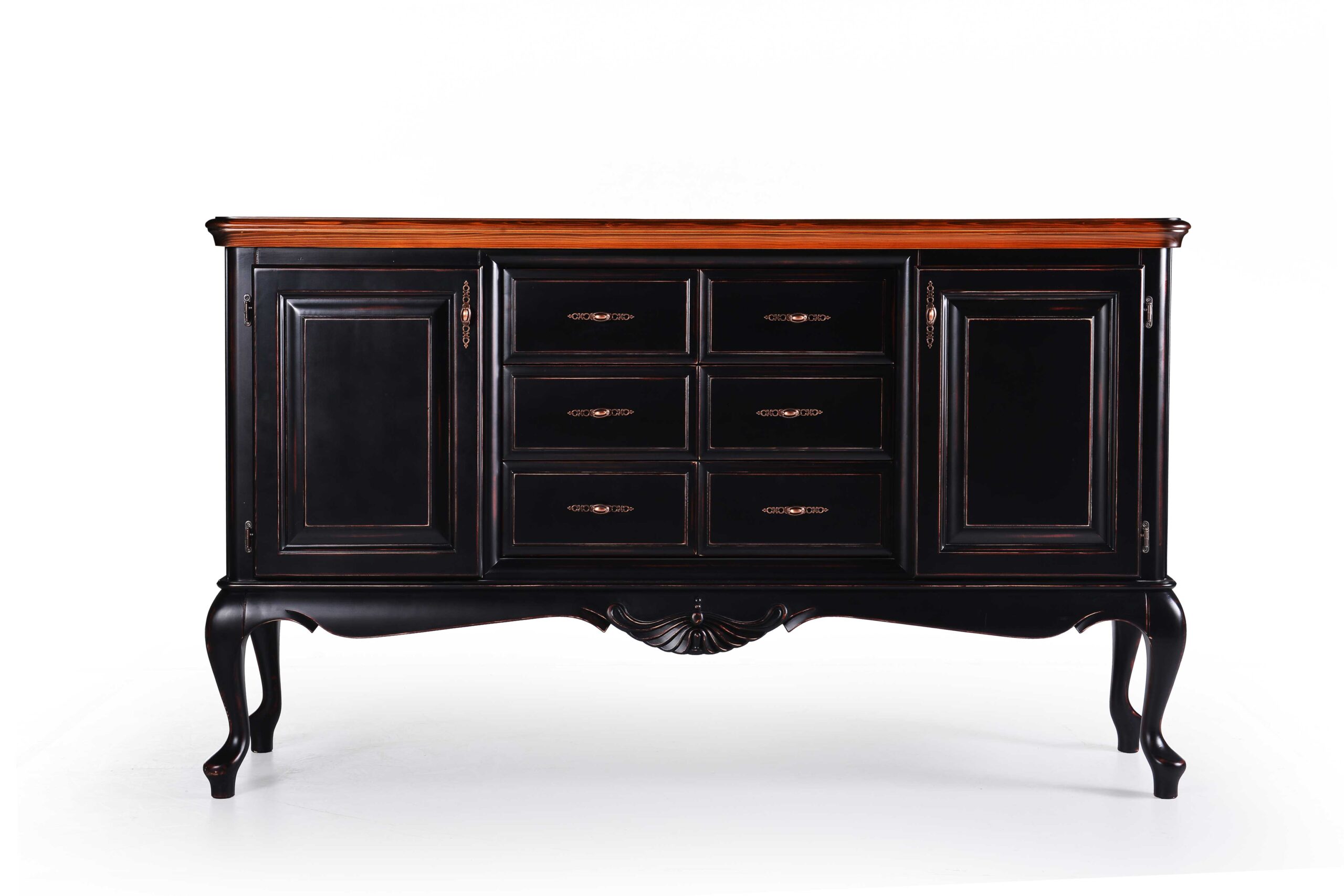
Once the size works, the first thing to look at is the mix of doors and drawers. If you’ll be storing flatware, napkins and small serving pieces, a cabinet weighted toward drawers will do the job; for large serving platters and pitchers, choose one weighted toward shelves behind doors. The Şato Console has four cabinet doors, the Elvin Console two doors and three drawers, and the Novel Console four doors and four drawers. You can see all the console models side by side on the category page.
Console height and depth
The 16 consoles at İmhotep range from 70 to 118 cm in height; fourteen of them fall between 87 and 110 cm. Depth runs from 49 to 60 cm and is 50 cm on most models. A low console (the Bodrum Console, 70 cm) makes the room feel more open and leaves wall space above it for a mirror or a large painting. A tall console (the Lükens Console, 118 cm) stands out more in the room; because its top sits above waist height, it suits low objects and a smaller mirror. For a living room console, too, depth and the wall set the size: leave at least 80–90 cm of walkway in front of a 50 cm-deep cabinet, and choose a width that leaves some wall clear at either end.
Console vs. chest of drawers
A console is the dining room’s long, horizontal cabinet, while a chest of drawers is a narrower bedroom piece with drawers made for storing clothes. Our consoles are 195–255 cm wide; our chests of drawers are 72–115 cm wide and 84–126 cm tall.
What is an entryway console, and what is it for? Sizes and placement
An entryway console is a narrow, shallow wall table used in entryways and hallways for dropping things off and displaying decor without narrowing the way through. Keys, wallet and mail land on it as you come home; a lamp brings light, a vase brings color, and a basket or box underneath corrals small items like umbrellas and scarves.
Entryway consoles are noticeably smaller than dining room consoles. At İmhotep, the three entryway console models with dimensions listed on their product pages are 130–140 cm wide, 35–44 cm deep and 80–95 cm tall. The shallowest of them is the Bodrum Entryway Console (130 × 35 × 95 cm), made entirely of oak. The Louis Entryway Console measures 140 × 40 × 93 cm, and the Lükens Entryway Console 130 × 44 × 80 cm. In a narrow hallway, choose a model no deeper than 35–40 cm and leave room to walk comfortably in front of it; most layouts recommend 80–90 cm for the walkway.
Where an entryway console goes: entryway, hallway and living room
An entryway console most often goes in the entryway or hallway, but it also works in the living room and the dining room: as a lamp surface behind the sofa, a display spot between two windows or a second serving surface on the wall opposite the console. At İmhotep, the Bodrum Dining Room Set includes the Bodrum Entryway Console, while for the Lükens Dining Room, an entryway console, a display cabinet and a bar cabinet are offered as pieces that complement the set. By the front door, you can hang a mirror above the entryway console and add a bench or a pouf beside it.
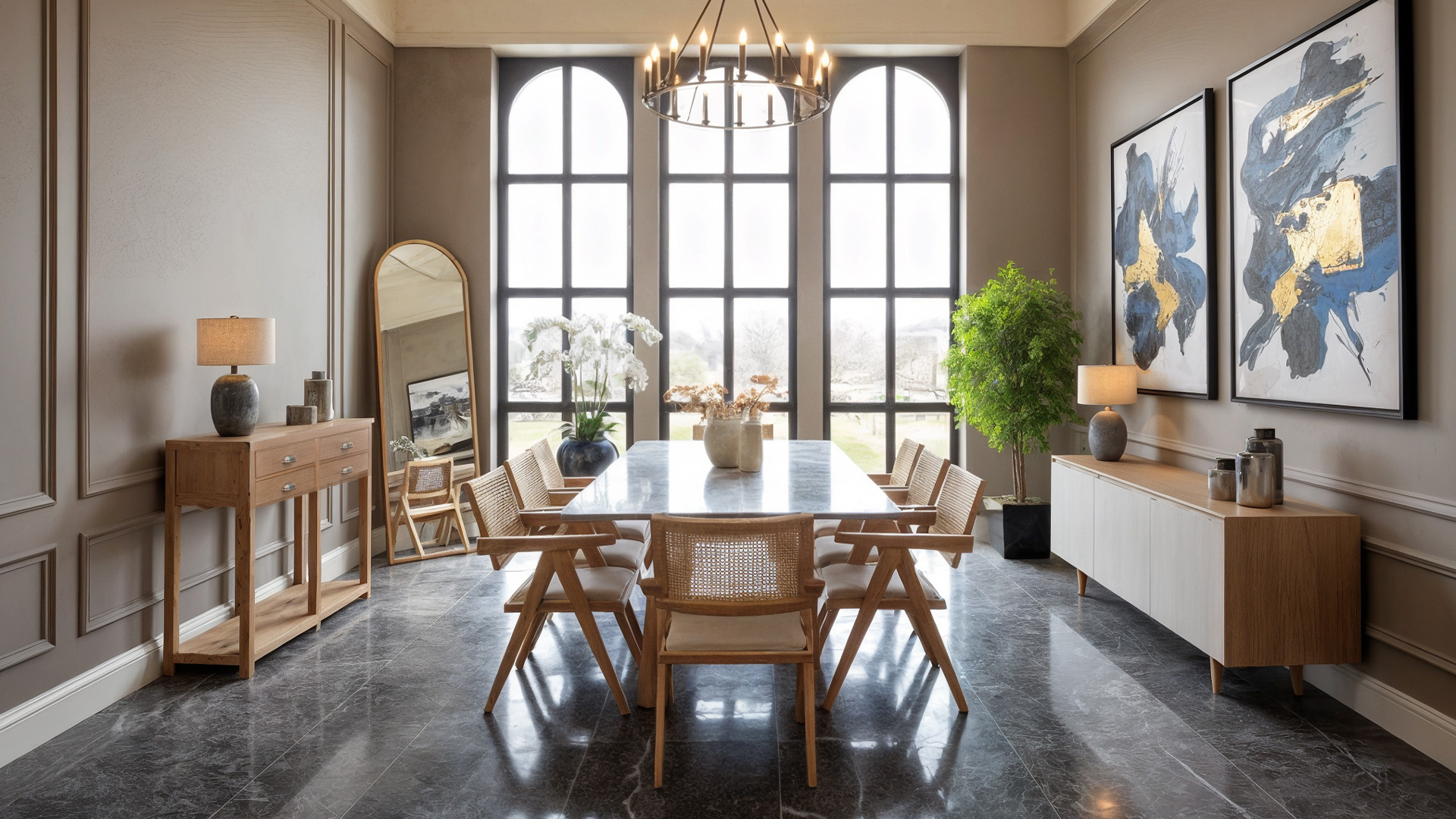
Decorating a console: mirror, accessories and TV
When decorating the top of a console, keep it simple: one large piece (a mirror or a painting), one tall piece (a lamp or a vase) and a few small objects are enough for most consoles.
- Mirror above a console: As a rule of thumb, a mirror looks balanced when it’s about two-thirds the width of the console. If its bottom edge sits about 15–25 cm above the console top, the mirror and the console read as one unit; put the lamp at one end, not in the middle.
- Accessories: In classic rooms that call for symmetry, set a lamp or a candlestick at each end and a bowl in the middle. For a more relaxed look, a tall vase at one end and a few stacked books at the other are enough.
- Serving space: In the dining room, don’t fill the top of the console completely; an empty spot for setting down plates and pitchers while serving always comes in handy.
- TV: You can put a TV on a console, but since most of our consoles are taller than 90 cm, the center of the screen often ends up above the eye level of someone sitting on the sofa. If you do put the TV on a console, secure it to the wall with an anti-tip strap; in the living room, a lower TV stand usually makes for more comfortable viewing.
Display cabinet, buffet and bar cabinet: showcasing and serving
A display cabinet is for showing things off, a bar cabinet for serving and a console for storing; a large dining room can hold all three together, while a small one usually has only the console.
Our display cabinet models are 164–220 cm tall: the Elvin Display Cabinet is 115 × 44 × 164 cm, the Lükens Display Cabinet 120 × 50 × 200 cm and the Novel Display Cabinet 170 × 50 × 220 cm. Made of kiln-dried spruce, the Novel Display Cabinet offers a display area for decorative objects and serveware thanks to its generous interior. When choosing a display cabinet, also measure the ceiling height and the space the doors will swing into.
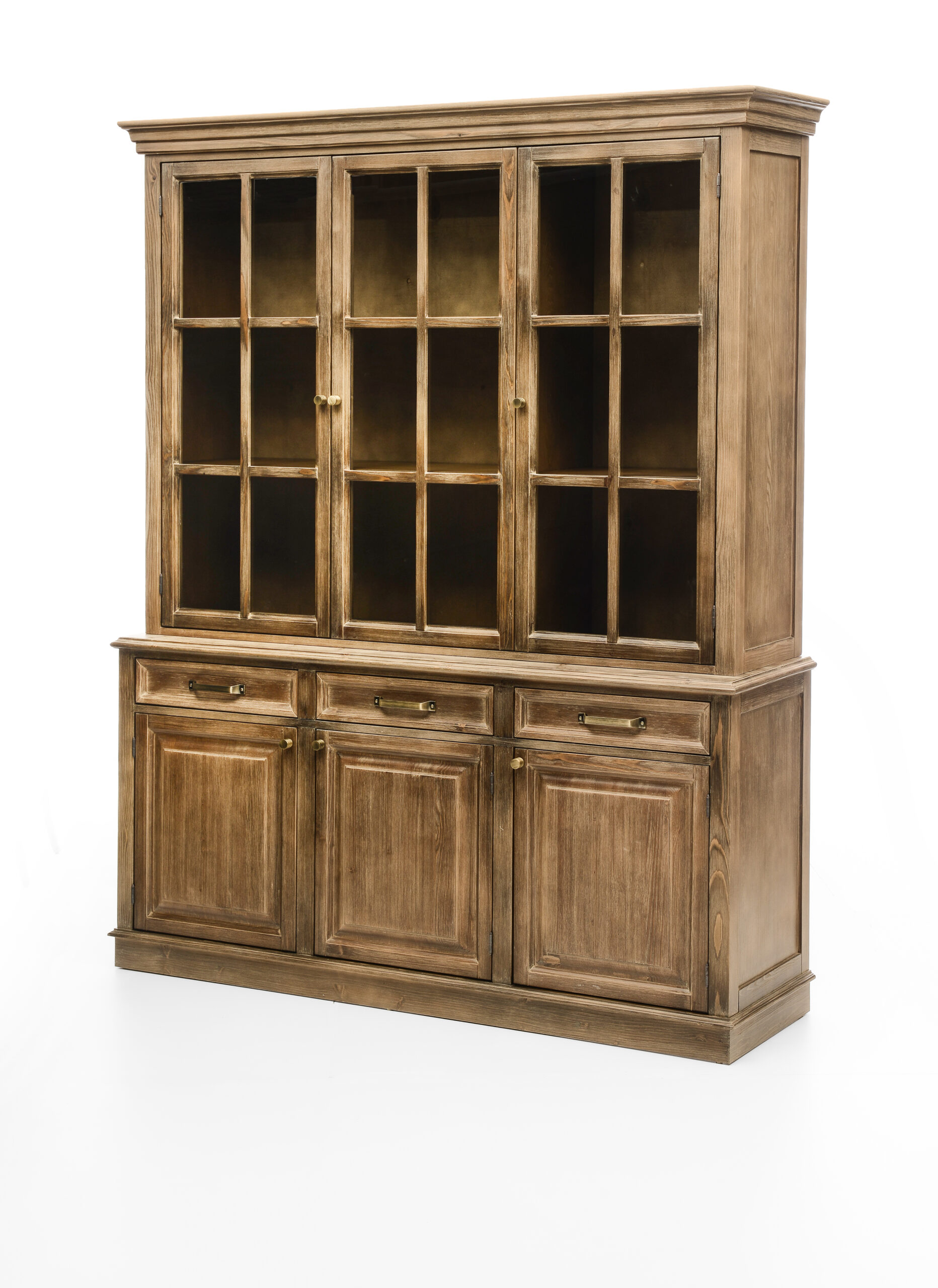
When people search for a buffet, the piece they mean is usually one of these two: a console if it’s low with doors, a display cabinet if its upper section is glass. Trying both names when you shop makes the search easier.
A bar cabinet keeps everything you need for serving drinks in one place. The Lükens Bar (105 × 46 × 197 cm) is designed as a complementary piece in a dining room set; its shelves and drawers hold glasses, bottles and accessories, and its serving surface is set aside for meze and drinks.
Which one should you choose? A quick summary
Let the room’s job decide: a console for storage in the dining room, an entryway console for a drop zone at the entrance, a display cabinet for showing things off and a bar cabinet for serving. When you measure, start with depth: where the passage is tight, a 35–44 cm-deep entryway console is enough; if at least 140 cm (90 cm of walkway + a 50 cm console) remains between the table edge and the wall, a 50 cm-deep console fits comfortably. Planning the console together with the table and chairs, as a set, cuts down on sizing mistakes; you can see consoles, display cabinets, dining tables and chairs together on our dining room furniture page. If you’d like to talk through sizes and wood color options in person, you’re welcome to stop by our showroom in Siteler, Ankara (Karacakaya Cad. No:141/A), weekdays from 8:00 a.m. to 7:00 p.m. and Saturdays from 9:00 a.m. to 6:00 p.m.
Frequently asked questions
What is a console used for?
In the dining room, it stores plates, glassware, flatware, tablecloths and serveware; its top is used for setting down dishes while serving and for a lamp and decorative objects. With its doors and drawers, it keeps everything the table needs a step away. In a large living room, it can also serve as a second surface for storage and decor.
What is an entryway console used for?
It gives you a drop surface in the entryway or hallway without narrowing the way through: a place for keys, wallet, mail, a lamp and a vase. Because it’s usually 35–45 cm deep, it fits tight spaces, and its few drawers corral small items. With a mirror hung on the wall above it, it becomes the spot for one last look before you head out.
Which room does a console go in?
Most often the dining room, on the wall facing the long side of the table, where it holds dinnerware and serving pieces. In an open-plan living room, it can also go on a wall in the dining area. A chest of drawers is the better choice for clothes in a bedroom, as is the shallower entryway console for a narrow entrance.
How tall is a console?
The 16 consoles at İmhotep are between 70 and 118 cm tall; fourteen of them fall between 87 and 110 cm, and depth is usually 50 cm. A low console makes the room feel more open and leaves space above it for a mirror, while a tall console becomes a more prominent focal point in the room.
Where does an entryway console go?
The entryway, the entrance hall and the hallway are the most common places; the ideal spot is a wall you see as soon as you open the front door, one the door doesn’t hit as it swings open. A model no deeper than 35–40 cm won’t block the way even in a narrow hallway; leaving about 80–90 cm in front of it for walking is enough.
Can you use an entryway console in the living room?
Yes. In the living room, an entryway console becomes a surface for a lamp and books behind the sofa, a display spot between two windows or a serving surface in the dining area. If you place it behind the sofa, it looks more balanced when its height is close to the sofa back or slightly lower. Because it’s shallow, it doesn’t narrow the walkway in the living room either.