What Is a Bergère Armchair? Differences, Sizes and How to Choose
What sets a bergère apart from a single armchair or a chaise? Using the real sizes of 14 İmhotep armchairs, we explain what to look for in the frame, foam and fabric.
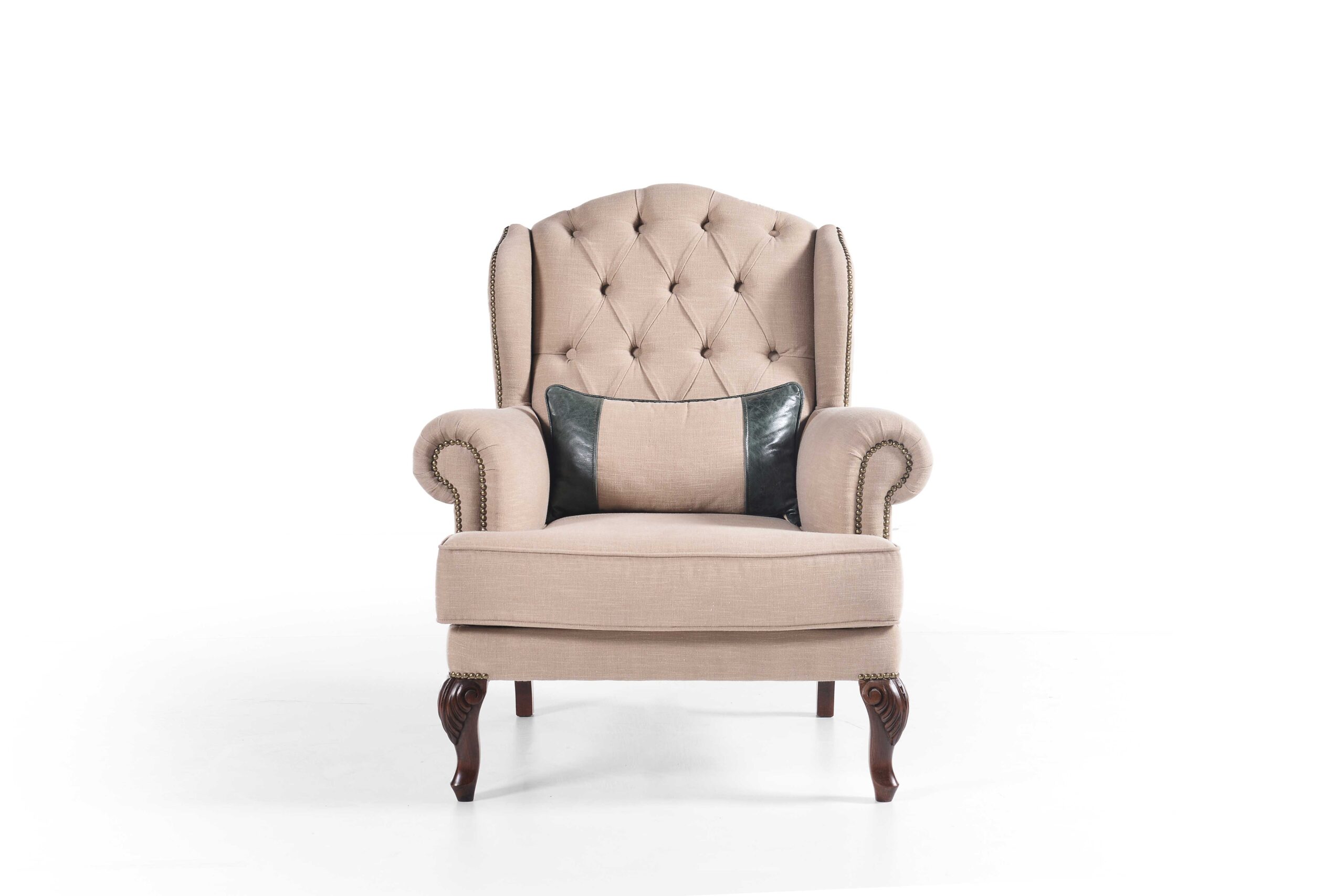
A bergère is an armchair: a single-seat chair with arms, usually built on a wooden frame and fully upholstered. In the living room it completes a sofa set; in a bedroom or reading nook it can also stand on its own. What sets it apart from a plain single armchair is its form: the back, arms and legs of a bergère are more clearly defined. Across the 14 İmhotep armchairs in our size chart, widths range from 60 to 105 cm and heights from 75 to 113 cm.
What is a bergère armchair, and what is it for?
A bergère is an upholstered armchair made for one person to sit upright in comfort; it is used either to complete the main seating group or to give a corner its own character. It is designed for sitting, not for stretching out like a sofa. That is why the back angle, arm height and seat depth are worked out together.
In everyday use, a bergère has three jobs:
- Completing the seating group: One or two armchairs go opposite or beside a three- or four-seat sofa, so there are more seats when guests come over.
- Creating a corner: With a lamp and a small side table, it becomes a reading or tea corner.
- Personal relaxation: High-back, wingback or reclining models suit long hours in front of the TV.
The İmhotep Arizona, Elegance and Venedik sofa sets each include two armchairs; in the Venedik set they sit alongside a Chesterfield sofa and a four-seat sofa. The Bodrum Armchair is meant for both roles: a supporting piece in a seating group, or the main piece in a small space.
Bergère vs. single armchair, chaise (josefin) and rocking chair
All four are mainly designed for one person to sit or rest, but their forms and uses differ. A bergère stands out with its defined back and arms; the single armchair in a sofa set repeats the sofa's form; a josefin is made for reclining, a rocking chair for rocking.
| Piece | How to recognize it | Where it is used | İmhotep example (W × D × H) |
|---|---|---|---|
| Bergère | Has arms and a defined back; on most models the wooden legs and arms show | Living room, reading nook, bedroom | Venedik Armchair, 90 × 76 × 109 cm |
| Single armchair (the one in a sofa set) | Usually repeats the form and fabric of the sofa in the set | Within a sofa set | No separate single-armchair product; the closest example is the Idea Armchair, which also works within a set, 100 × 96 × 75 cm |
| Josefin (chaise) | Long body, suited to half-reclining; on most models one end rises | Bedroom, living room corner | — |
| Rocking chair | Legs rest on curved runners and it rocks back and forth | Reading nook, family room | Rocking Chair, 60 × 110 × 100 cm |
"Single armchair" is the general name for one-seat armchairs; every bergère is a single armchair, but not every single armchair counts as a bergère. The İmhotep Idea Armchair, with its clean lines, can stand alone or within a set; it looks close to a single armchair yet carries the bergère name.
A josefin is a long, upholstered seat on which you can stretch out your legs and half-recline. A rocking chair sways gently on its curved runners; the İmhotep Rocking Chair is made from beech lumber, has a tufted back and velvet upholstery, and features swan-shaped handwork on the arms.
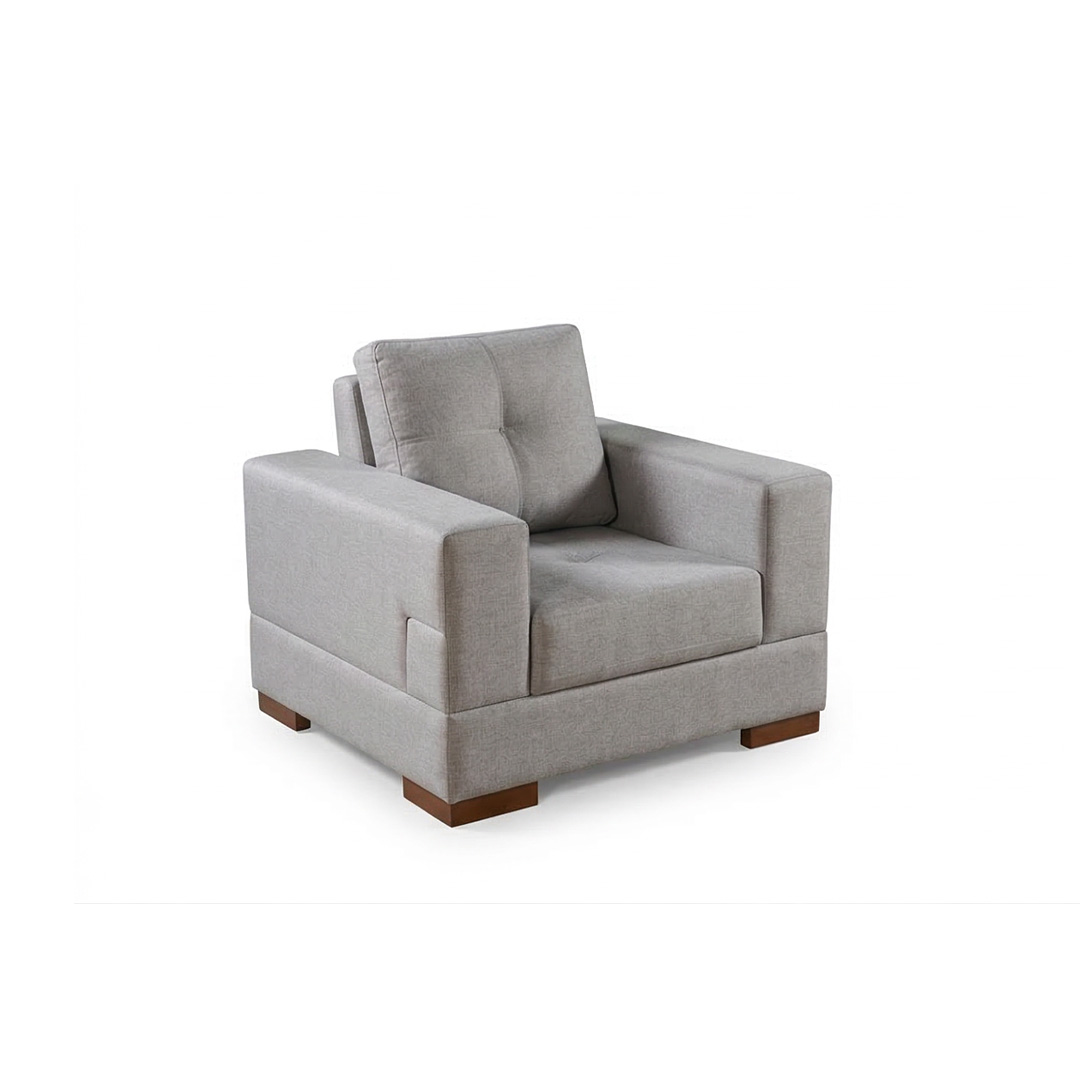
Bergère armchair sizes: a size chart from İmhotep models
Bergère sizes vary widely by model: across the 14 İmhotep armchairs below, width runs 60–105 cm, depth 60–105 cm and height 75–113 cm. The tallest model is the Elegance at 113 cm; the wingback or high-back Venedik, Lizz and Arizona are also 105–110 cm. The low-slung Chesterfield, Idea and Milton stay at 75–78 cm.
| Model | W × D × H (cm) | Key feature |
|---|---|---|
| Milton Armchair | 60 × 60 × 78 | Bamboo cane on the back |
| Prada Armchair | 67 × 72 × 100 | Tufted back and seat, turned legs |
| Craft Armchair | 68 × 65 × 107 | Tufted back, hand-carved details |
| Arizona Armchair | 70 × 74 × 110 | High back, hand-carved details |
| Louis Armchair | 71 × 60 × 95 | Classic lines |
| Elegance Armchair | 73 × 68 × 113 | Wide back, linen-texture fabric |
| Elvin Armchair | 76 × 66 × 107 | Gingham-check fabric |
| Lizz Armchair | 77 × 60 × 105 | High back, cane detail |
| Novel Armchair | 85 × 80 × 100 | Wide seat, linen-texture fabric |
| Bodrum Armchair | 85 × 80 × 92 | Simple form, piping |
| Venedik Armchair | 90 × 76 × 109 | Wingback form, tufted back |
| Şato Armchair | 91 × 80 × 102 | Deep seat, straight lines |
| Idea Armchair | 100 × 96 × 75 | Reclining back |
| Chesterfield Armchair | 105 × 105 × 78 | Hand-tied button tufting, brass casters |
Furniture has no single standard armchair size; with most makers, width is around 65–100 cm, seat height usually 40–48 cm and seat depth 50–60 cm. When measuring, check three things: the width of the spot where the armchair will go, the walking space left in front of it, and whether it will fit through your doors and elevator. Because an armchair is usually tipped on its side when carried, what decides whether it clears a door is usually not its width but the smaller of its depth and height: the Chesterfield Armchair is 105 cm wide but only 78 cm high. Models with a depth approaching 100 cm can narrow the walkway in a small living room; with reclining models, leave room behind as well.
How to choose a bergère: frame, foam, fabric and form
How long an armchair lasts depends largely on what sits beneath the upholstery: a dried, sturdy wooden frame and dense foam that holds its shape. Add a fabric suited to how hard it will be used and a back that suits how you sit, and the choice is complete.
Frame wood
The frame is the load-bearing wooden body under the upholstery. Wood that has not been dried enough moves as it gives off moisture over time and can loosen the joints; kiln-dried wood is wood whose moisture has been brought down in a kiln under controlled conditions. The frames of the Venedik, Elegance Armchair and Idea models are made of first-grade kiln-dried hornbeam.
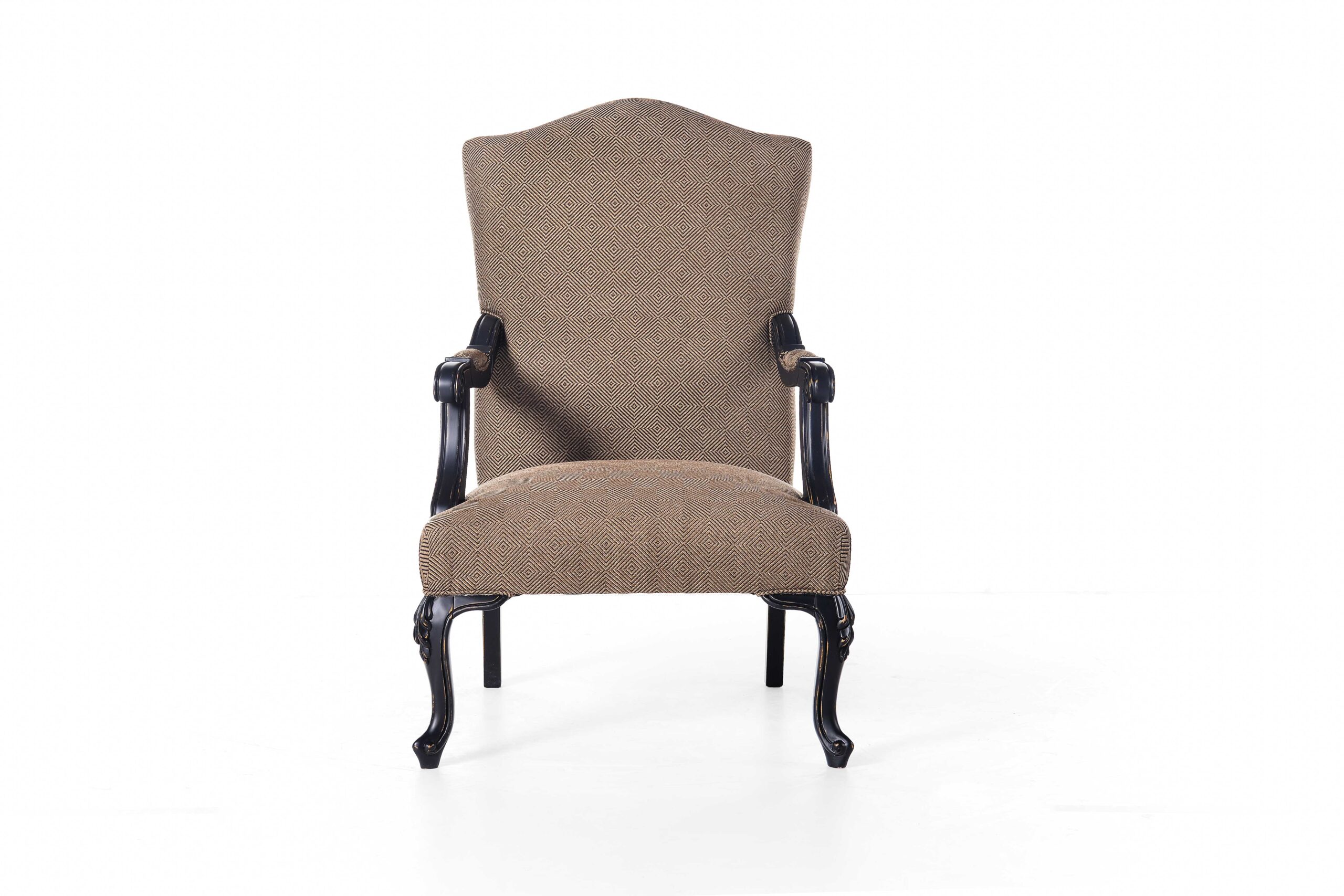
Foam density
Density is how dense the foam is; "35 density" usually refers to foam that weighs about 35 kg per cubic meter. Density is not the same as firmness, but as density rises, foam generally resists sagging better and keeps its shape longer. The seats of the Venedik, Elegance and Idea armchairs use 35-density foam.
Fabric
Choose the fabric based on who will use the armchair and how often. Linen-texture fabric looks matte and natural, while velvet gives a softer, more lustrous surface. In busy homes, easy-to-clean fabrics come first; the Idea Armchair's linen-texture fabric is water-repellent and easy to clean. If you want the armchair to stand apart from the set, you can choose a different fabric: in the Arizona Sofa Set, the three-seat sofas are upholstered in gray linen-texture fabric, while the armchairs use a patterned fabric in beige, mink and gray tones.
Back height, wings and mechanism
Wings are the projections that extend forward from both sides of the back, framing the head and shoulders from the side. Wingback and high-back armchairs support the head during long sitting; low-back ones look lighter in a living room. The Venedik Armchair, with its wingback form and tufted back, is an example of the first group. If you want a chair for relaxing, look at the mechanism: the back of the Idea Armchair reclines and it can be used as a TV chair.
Tufting
Tufting (kapitone) is a technique in which the upholstery fabric or leather is pulled inward at set points with buttons or stitching to create a raised, patterned surface; you can find a detailed definition in our article What is a Chesterfield sofa. On the Chesterfield Armchair, the buttons are hand-sewn using the hand-tied method.
Where to put a bergère, and how to arrange it
A bergère is most often used as part of the seating group in the living room, by the window in a bedroom, and as a reading chair in a quiet corner of the home; in every case it needs comfortable clearance in front and a surface beside it to set things down.
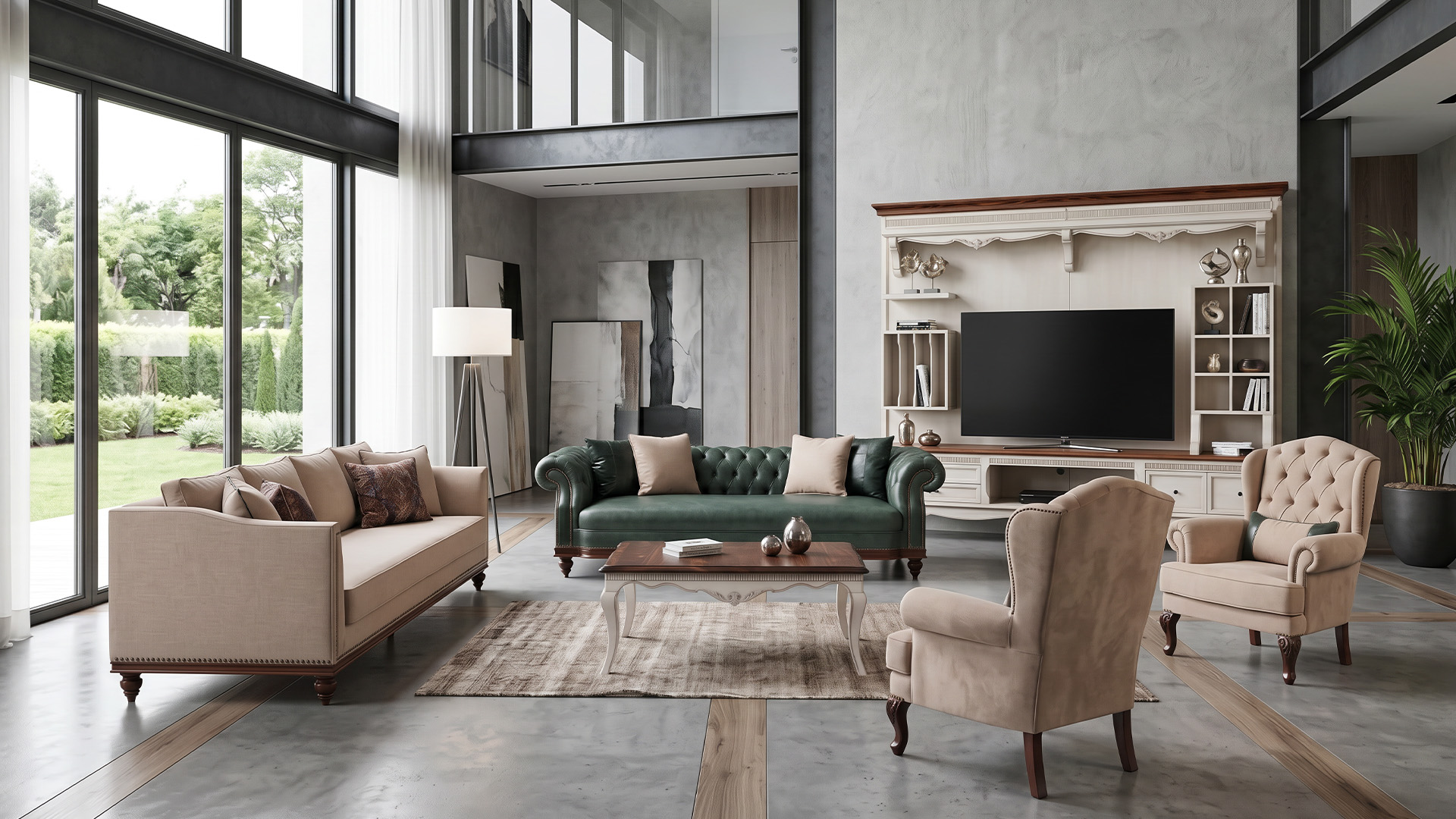
- Living room: Two armchairs go opposite the sofa or on either side of the coffee table, angled slightly toward each other, so everyone can easily reach the table and join the conversation.
- Bedroom: A spot by the window or an empty corner works well; a single armchair gives you a place to sit while dressing and to read.
- Reading nook: Put a floor lamp and a small side table at arm height next to the armchair.
Usually 40–50 cm is left between an armchair and the coffee table; if people will walk in front of it, you need at least 60 cm, and 75–90 cm for a comfortable path. You can find the sizes of side tables and accent tables for armchairs in our article on coffee table sizes. If you like to put your feet up, you can add a pouf in front of the armchair. For different sizes and shapes, take a look at our pouf models.
In short: a checklist for choosing a bergère
Three things make the right armchair: it fits its spot, it supports the person sitting in it, and it is upholstered in a fabric that suits how your household uses it. Four points to check:
- Measure the space: the width and depth of the armchair, plus at least 60 cm of clearance in front.
- Choose the back for how you will use it: a high back or wings for long sitting, a low back for a lighter look.
- Ask about the frame and foam: wood species, drying method and foam density.
- Pick the fabric to match your household's pace: easy to clean for heavy use, a fabric different from the set for an accent piece.
You can compare İmhotep's bergère armchair models using the sizes on their product pages; on models such as the Venedik and Elegance, you can choose different colors and textures from the wood and fabric swatch cards. If you would like to see the models and fabric swatches in person, you can visit our showroom in Siteler, Ankara (Karacakaya Cad. No:141/A), weekdays 08:00–19:00 and Saturdays 09:00–18:00. You can call 0 312 351 03 32 to ask whether the model you want to see is on display.
Frequently asked questions
What is a bergère armchair used for?
A bergère is for one person to sit upright in comfort. In the living room it completes the sofa set and adds seating; in a bedroom or by a window it becomes a reading and relaxing chair. Wingback or reclining models are better for sitting for long periods, while low-back models suit entertaining guests and a lighter look in the living room.
What is the difference between a bergère and a single armchair?
"Single armchair" is the general name for one-seat armchairs; a bergère is the member of this group with a more defined form. On a bergère, the back, arms and legs each have their own character, the wooden parts often show, and the fabric can be chosen to differ from the set. The single armchair that belongs to a set usually repeats the sofa's form and fabric.
Where should a bergère go?
Its most common place is the living room, where it adds seating next to the sofa set. In a bedroom, a spot by the window or an empty corner works well for sitting while dressing and for reading. In a quiet corner of the home, a floor lamp and a small side table turn it into a reading nook. Pass-through areas such as an entryway are usually too tight for an armchair.
How big is a bergère armchair?
There is no single standard size. Across the 14 armchairs in İmhotep's size chart, width ranges from 60 to 105 cm, depth from 60 to 105 cm and height from 75 to 113 cm; 11 of these models are 65–91 cm wide. The wingback and high-back models in the chart reach 105–110 cm, while the low-slung Chesterfield, Idea and Milton are 75–78 cm high.
What is a josefin chair?
A josefin is a long, upholstered seat suited to sitting with your legs stretched out or half-reclining; on most models one end rises. It differs from a bergère in being designed for resting rather than sitting upright. It is usually placed in a bedroom or a quiet corner of the living room for reading while stretched out or taking a short break.
How should bergère armchairs be arranged?
Two armchairs usually go opposite the sofa or on either side of the coffee table, angled slightly toward each other. Leave 40–50 cm between them and the coffee table, and at least 60 cm where people walk in front of them. Placing a small side table at arm height between or beside the armchairs gives you room for a glass and a book.