How to Choose a Sofa Set: A Guide to Size, Frame, Foam and Fabric
What to check when buying a sofa set, in order: size, frame, foam, fabric and color, plus the questions to ask the seller.
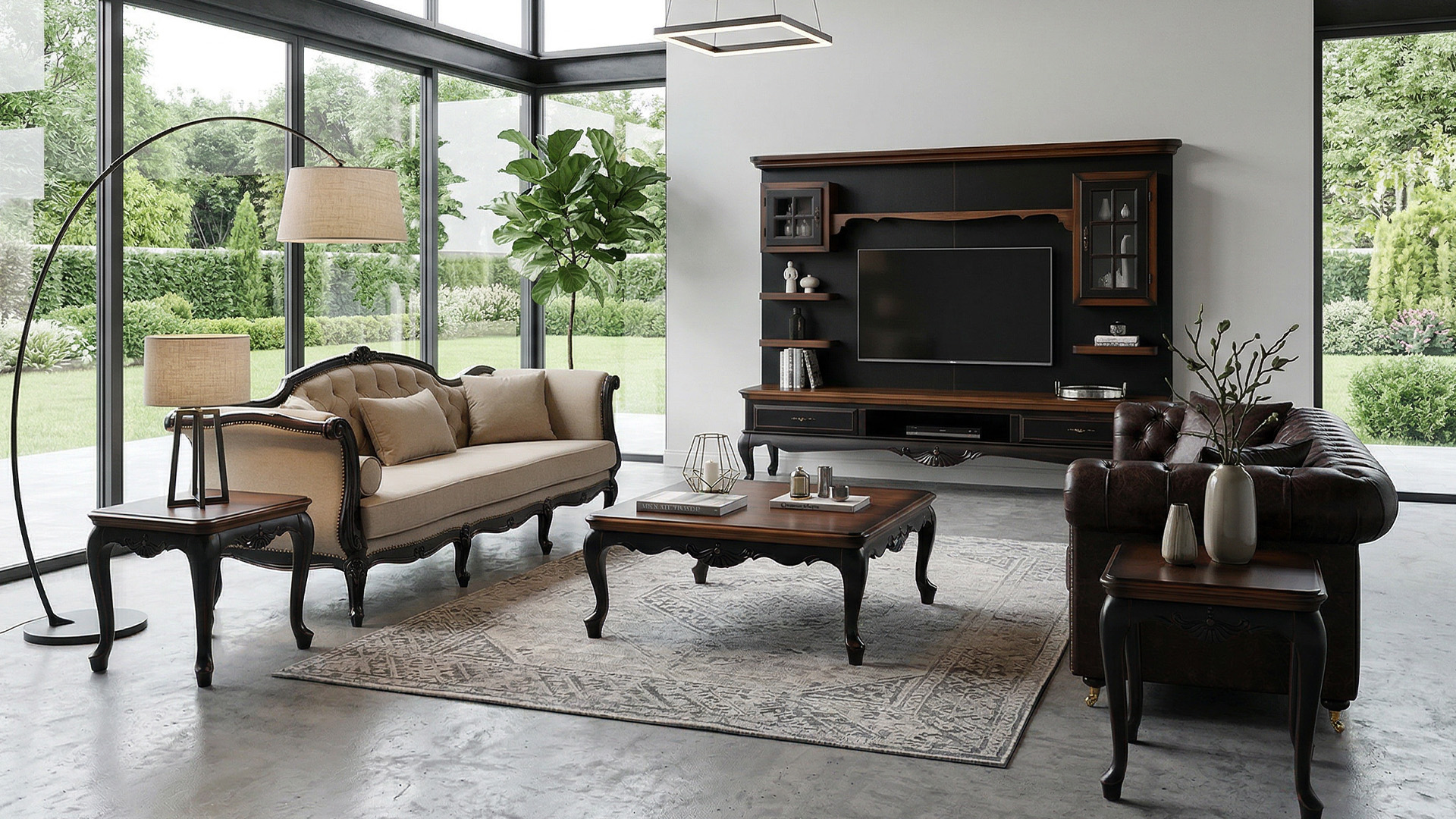
When choosing a sofa set, order matters: measure the room and doorways first, and let the numbers decide between a corner sofa and a set. Then ask about the hidden parts: the frame’s wood, whether it was kiln-dried and the foam’s density. Choose fabric and color last: fabric for daily use, color for the wood tone. Fabric can be replaced years later; the frame stays for the sofa’s lifetime.
How to choose a sofa set: a 6-point checklist
A good sofa set should fit the living room and the doorways, have its frame and foam clearly stated, and come in a fabric that suits how the home is used. Before you go to the store, take this list with you:
- Size: Write down the wall lengths, the width of the doors and the elevator, and the seat depth you want.
- Corner sofa or set: Decide based on the shape of the room and on your conversation and TV habits.
- Frame: Ask what wood it’s made of and whether it was kiln-dried.
- Foam: Find out the density and the type of the seat foam.
- Fabric: Choose it with children, pets and sunny windows in mind.
- Color: Keep the large pieces calm and move color and pattern to the armchairs and pillows.
Measure first: living room, doorways and seat depth
Measure the room first, not the furniture. Sketch the walls, window, radiator, doors and outlets on paper. Then measure the way in: the building entrance, the inside dimensions of the elevator, the turns in the stairs and the clear width of the apartment door. Since sofas are often carried on their side, whether one fits through a door usually depends not on its width but on the smaller of its depth and height; for high-backed models, also ask the seller for the diagonal measurement.
The depth on product pages is usually the sofa’s overall depth, back to front. Comfort depends on seat depth: the distance from the cushion’s front edge to the backrest. If you like to sit upright, 50–55 cm usually feels right; if you tuck your legs under you or like to sprawl, 60 cm or more. Seat height on most sofas is 42–48 cm off the floor; very low, deep seats can make getting up harder for older people. Product pages often leave out these two numbers, so ask the seller for them and for what the listed depth covers.
The product page dimensions of a few İmhotep models show that even sofas with the same label take up different amounts of space:
| Model | Width | Depth | Height |
|---|---|---|---|
| Elvin 2 Seater Sofa | 215 cm | 90 cm | 93 cm |
| Idea 3 Seater Sofa with Adjustable Armrest | 220 cm | 96 cm | 75 cm |
| Prada 3 Seater Sofa | 240 cm | 91 cm | 80 cm |
| Venedik 4 Seater Sofa | 240 cm | 90 cm | 80 cm |
Go by the centimeters, not the label: there’s a 20 cm difference between the two three-seaters, the Elvin 2 Seater Sofa is only 5 cm narrower than the Idea 3 Seater Sofa with Adjustable Armrest, and the Venedik 4 Seater Sofa is the same width as the Prada 3 Seater Sofa.
How many pieces should a sofa set have?
Let the size of the living room, not the name of the set, decide the number of pieces. Sets often go by shorthand like “3+3+1” or “3+2+1+1”: the 3 and the 2 show how many people each sofa seats, and the 1s are single-seat pieces. That single seat is usually a bergère-style armchair (berjer in Turkish): an upholstered chair with arms and a pronounced back, made for one person to sit upright in comfort. How it differs from a single-seat sofa that repeats the set’s design is covered in our article on what a bergère is. Here’s what a few sets in the collection include:
| Set | Seating pieces | Complementary pieces |
|---|---|---|
| Arizona | Two tufted three-seat sofas, two armchairs | Coffee table, TV stand |
| Şato | Two three-seat sofas, one armchair | TV unit, accent table |
| Noa | Two three-seat sofas, two armchairs | None; the set includes no tables or TV units |
| Lükens | One wooden sofa, one chesterfield sofa, two armchairs | Coffee table, TV unit, side table |
The chesterfield in the table is the classic sofa known for its button-tufted back and its rolled arms set at the same height as the back; tufting is the raised pattern made by pulling the upholstery in with buttons at regular intervals. In a small living room, a set of one three-seater and one two-seater often fits more easily than one with two three-seaters.
Corner sofa vs. sofa set: how they compare
A corner sofa (an L-shaped sectional) is the better fit for living rooms with plenty of wall space in an L shape, where many people sit side by side facing the TV; a sofa set is better for homes that want a conversation layout and a flexible arrangement, or that may move someday.
| Criterion | Corner sofa | Sofa set |
|---|---|---|
| Seating capacity | More people fit along the same wall, and the corner gets used too | Depends on the number of pieces; gaps are left at the corners |
| Stretching out | Comfortable on models with a chaise module | Usually provided by an armchair or a pouf |
| Layout flexibility | Unless it’s modular, you pick a right- or left-hand orientation up front | Pieces can be moved into another layout or another room |
| Moving | Unless it’s modular, it can be a struggle at doors and in elevators | Pieces are carried one at a time |
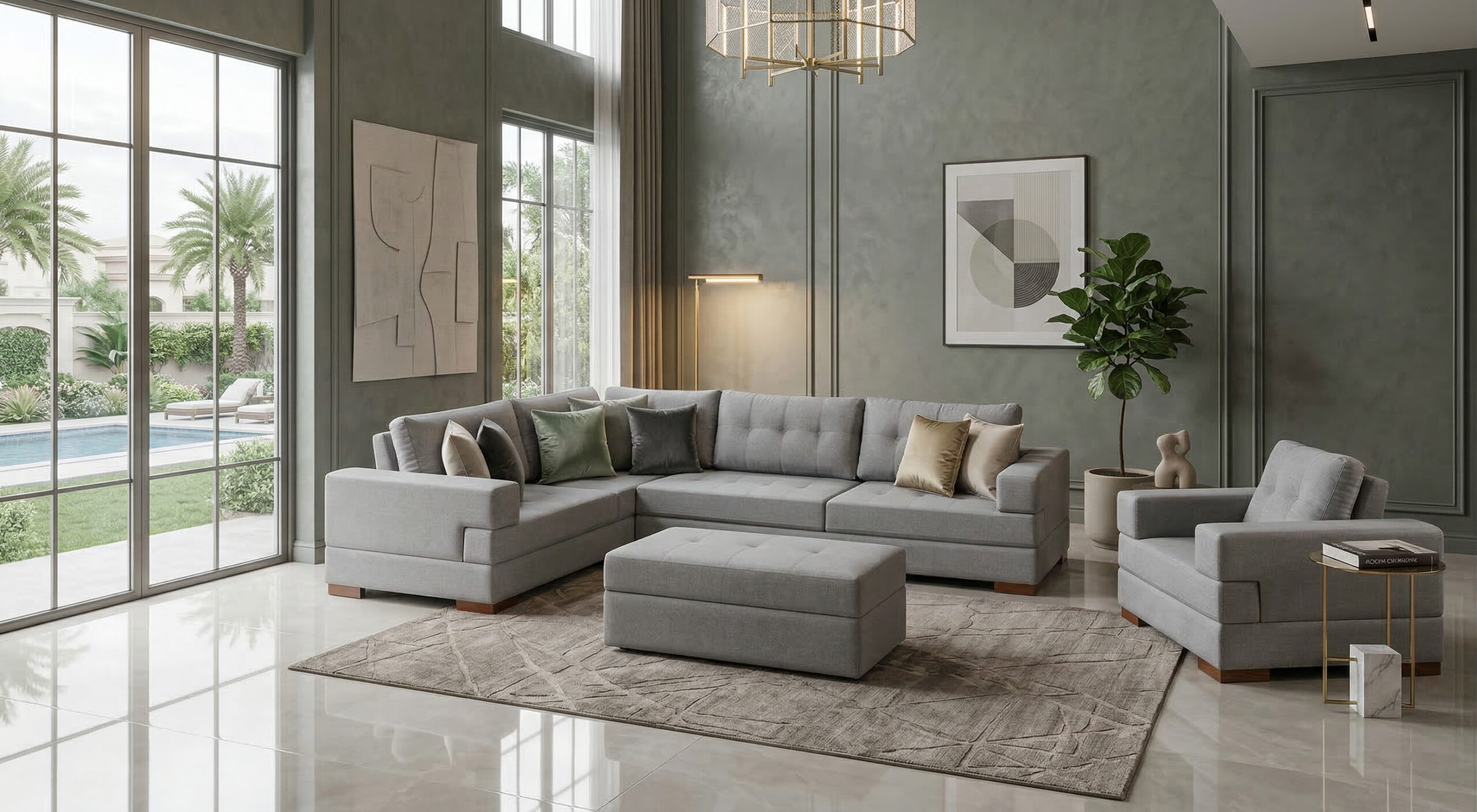
At İmhotep, most of the choice is in sofa sets; the corner sofa category has two models: the Idea Corner Sofa (230x320 cm on its product page) and the Verona Corner Sofa, which has a chaise module. If you’re undecided, the Idea Sofa Set offers a middle path: its three-seater with adjustable armrests works as a classic sofa with both arms open and as a corner sofa with one arm open, and its three-seater with an adjustable backrest goes into a bed position when the back is opened.
Frame and foam: what to look for in the parts you can’t see
How long a sofa set lasts depends largely on two things you can’t see: the wood of the frame and how it was dried, and the density of the seat foam.
Frame: which wood, and how was it dried?
A sturdy frame is usually made of kiln-dried solid wood; some manufacturers also use high-quality multi-ply plywood in certain sections. Kiln-dried wood is wood dried in controlled chambers to bring its moisture down; a frame made from it is less likely to crack, warp or squeak over time. Hornbeam is widely used in sofa frames because it’s hard and close-grained.
Look for this in the product description; if it’s missing, ask the seller for it in writing. For example, the Louis Tufted Sofa’s frame is kiln-dried hornbeam, the Chesterfield Sofa’s is top-grade kiln-dried hornbeam, and the Elegance Armchair’s is top-grade kiln-dried solid hornbeam. Also ask the seller:
- What wood is the frame, and was it kiln-dried? If any part uses plywood or particleboard, which one?
- Are there springs or webbing under the seat?
- Can the legs be removed for moving?
Seats usually rest on elastic webbing or zigzag (sinuous) springs; either way, they should be closely spaced and firmly attached to the frame.
Foam: what do density and HR mean?
Density is how heavy a foam is for its volume; “35 density” usually means a cubic meter of the foam weighs about 35 kilograms. Density isn’t the same as firmness; it’s more a sign of how well the foam resists sagging. HR (high resilience) is the name for a more elastic class of foam that springs back quickly when pressed; “35 HR” usually means HR foam of that density.
Both terms appear in the descriptions of the three examples above: the Louis Tufted Sofa has 35 HR foam, while the Chesterfield Sofa and the Elegance Armchair have 35-density foam. In Turkish product descriptions, “35 densite” is sometimes spelled “35 dansite” and sometimes shortened to “35 DNS.” Still, the most reliable test is to sit: stay seated for a few minutes, then watch how long the cushion takes to recover after you stand up.
Fabric and color: which fabric for which home?
There’s no single best sofa set fabric for everyone; it comes down to how the home is used: children, pets, sunny windows and whether people eat on the sofa. Here’s how the common options compare:
| Fabric | Main advantage | What to watch for | Suited to |
|---|---|---|---|
| Linen-textured fabric | Matte, natural look | Dirt shows quickly on light shades; coarse weaves can be vulnerable to claws | Homes that want a simple, natural look |
| Velvet | Deep color, soft feel | The shade shifts in the light with the direction of the pile; rubbed spots can show marks | Statement living rooms |
| Genuine leather | Gains character over time | Needs regular care and can fade in the sun; most leather wipes clean with a slightly damp cloth, but for aniline and nubuck, follow the manufacturer’s advice | Classic and chesterfield-style living rooms |
| Faux leather | Wipes clean easily, low maintenance | Low breathability; depending on quality, the surface can peel over time | Areas that need frequent wiping |
| Water-repellent fabric | Doesn’t soak up spills right away, so you have time to wipe them | Not stain-proof; spills still need to be wiped up promptly | Homes with children, heavy everyday use |
Judge a fabric by its texture and abrasion resistance more than by its name; names you’ll hear in Turkish stores, such as babyface or tay tüyü (“foal hair”), usually mean short-pile, velvet-like fabrics. The Martindale test measures abrasion resistance; the result shows how many rub cycles a fabric withstands before it shows wear. For a heavily used home, choose a higher number.
Three of these fabrics are also found in the İmhotep collection: the Elegance Armchair is upholstered in a natural linen-textured fabric, and the chesterfield sofa and armchairs of the Lükens Sofa Set in genuine crackle-finish leather; according to its description, the Idea Sofa Set’s fabrics are easy to clean, breathable and water-repellent.
Choosing sofa set colors that work together
The safest color strategy is to keep the large pieces calm and move color and pattern to the smaller ones. The three-seaters are the largest surface in the living room; shades like beige, gray and taupe still work when the rug or curtains change. Armchairs, pillows and throws are lower-risk places to try pattern or bold color.
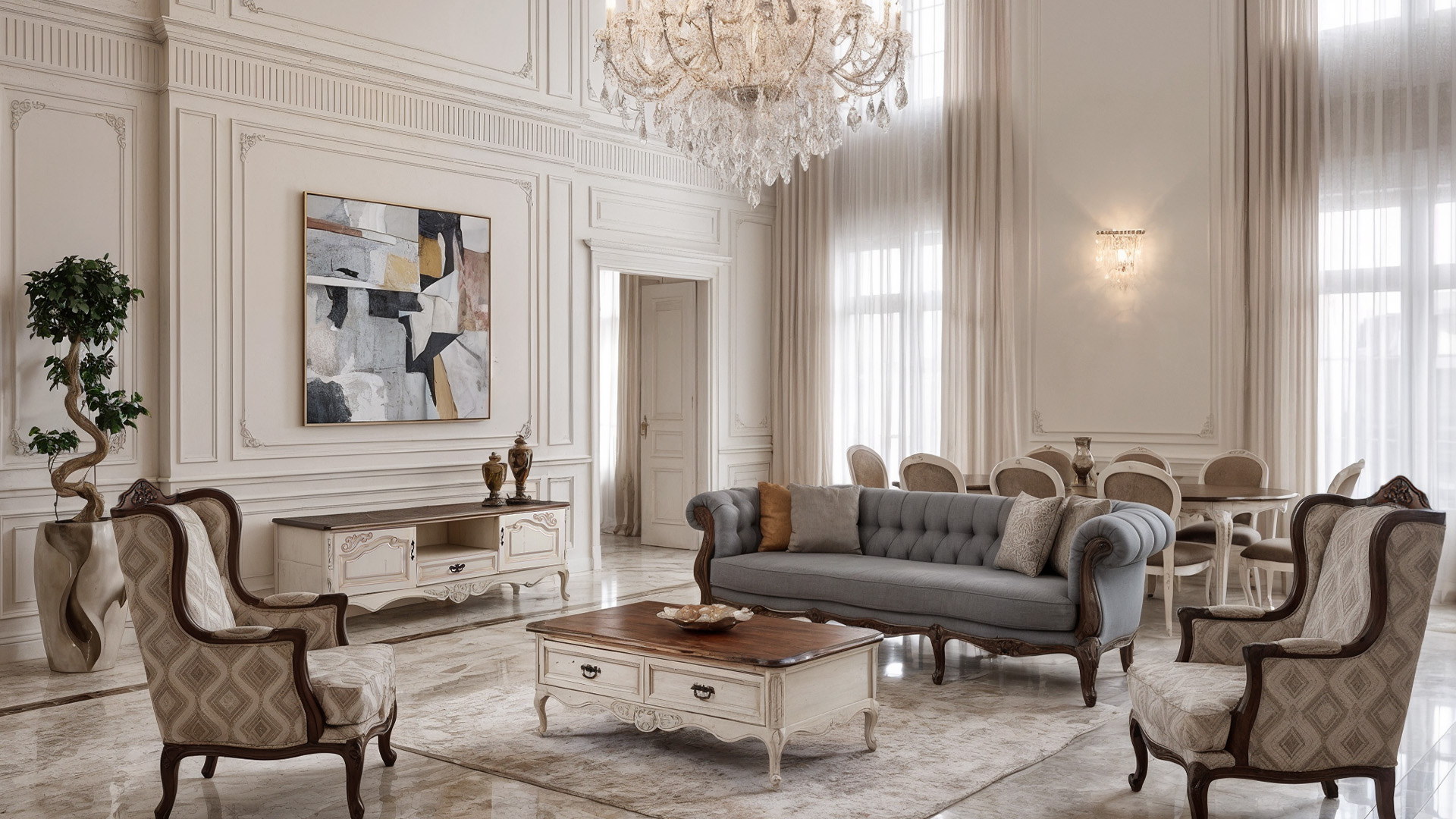
The Arizona Sofa Set is a good example of this approach: the three-seaters are covered in gray linen-textured fabric, the armchairs in a patterned fabric in beige, taupe and gray. The wood of the seating pieces is painted a walnut tone, while the bodies of the coffee table and the TV stand have a distressed cream finish. The Şato Sofa Set takes the opposite route: the pattern is on the three-seaters, in a beige-and-blue linen-textured fabric, while the armchair is in beige linen-textured fabric. Choose the fabric together with the wood tone, placing them side by side in the sample book (a catalog of wood and fabric samples) in daylight: the same gray fabric looks bolder against dark walnut and softer against light-toned wood.
Arrangement: facing, L-shaped and U-shaped layouts
A sofa set is arranged around the living room’s focal point: the longest sofa goes opposite the TV, the fireplace or the view, and the other pieces go beside it or across from it. There are three basic layouts:
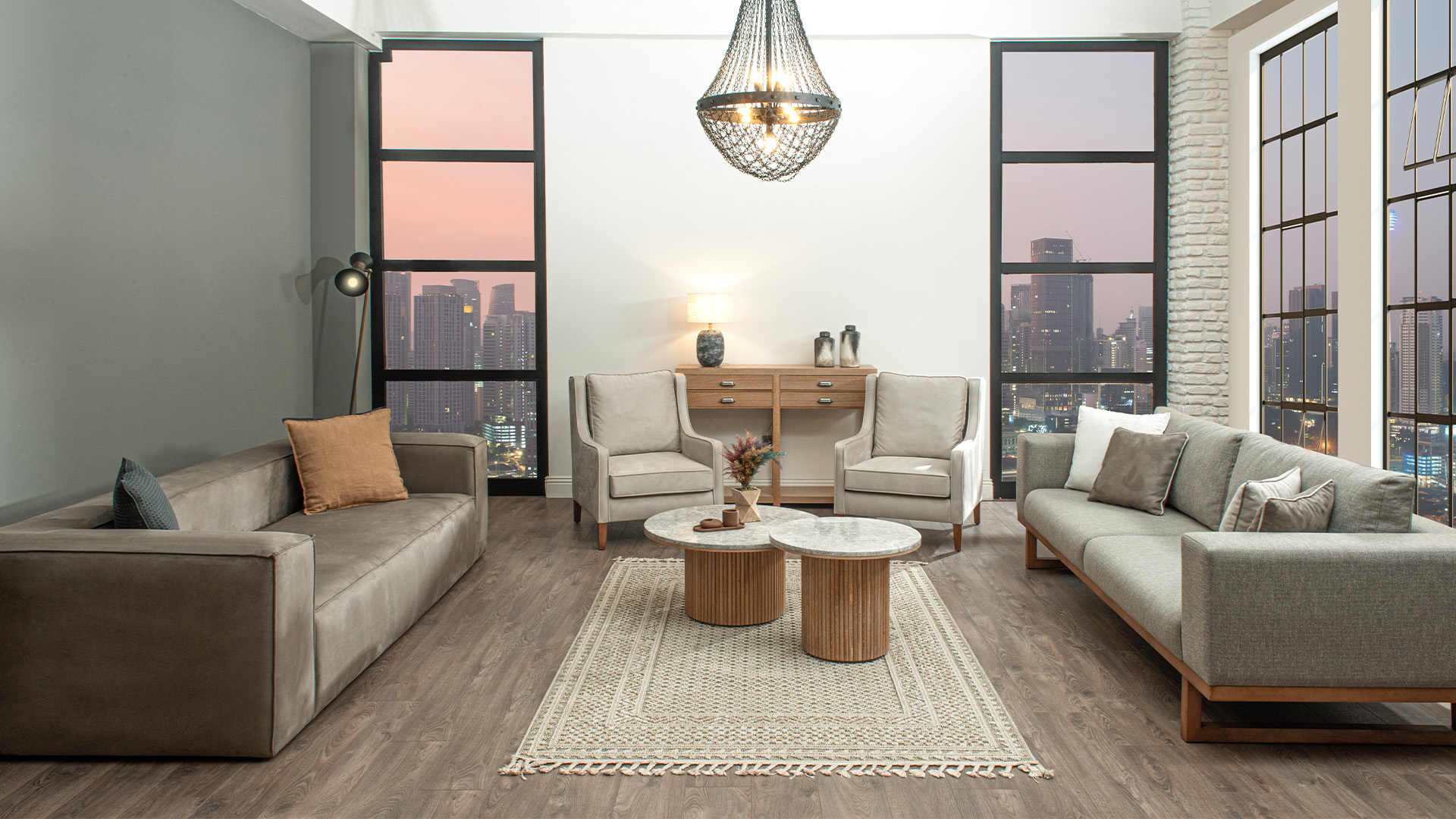
- Facing layout: Two sofas face each other, with the armchairs along the side between them. It’s good for conversation; the TV takes a back seat.
- L-shaped layout: The main sofa faces the TV, with the second sofa or the armchairs at a right angle beside it. It works for both watching and talking.
- U-shaped layout: Seating on three sides, with the fourth side left open. It’s for large living rooms; the coffee table stays at the center.
Sets of two three-seaters and two armchairs, like the Noa Sofa Set, fit easily into a facing layout. The usual gap is 40–50 cm between the sofa and the coffee table, with at least 60 cm for a path through the seating group and 75–90 cm for comfortable passage; the detailed math is in our guide to coffee table dimensions. Position the sofa that faces the TV according to screen size: for 4K screens, a viewing distance of 1 to 1.5 times the screen diagonal is generally recommended (roughly 1.4–2.1 m for a 55-inch screen).
What to look for when buying a sofa set: a quick summary
When buying a sofa set, keep to the order: the measurements and the corner-sofa-or-set decision first, then the frame and foam, and fabric and color last. Get the frame wood and foam density in writing. As you browse İmhotep’s sofa and sofa set models, you can compare the frame, foam and fabric details in the descriptions with this list and ask us about anything a description leaves out. If you’d like to try the sofas out in person, call ahead (+90 312 351 03 32) to ask which models are on display, then stop by our showroom in Siteler, Ankara (Karacakaya Cad. No:141/A), open 8 a.m. to 7 p.m. on weekdays and 9 a.m. to 6 p.m. on Saturdays.
Frequently asked questions
How many pieces are in a sofa set?
Most sofa sets have three or four seating pieces: two sofas (three-, two- or four-seaters) and one or two armchairs. Some sets also include a coffee table, a TV unit and a side table. Decide on the number of pieces based on the size of your living room, not on what a ready-made set happens to include.
What color should a sofa set be?
Calm shades such as beige, gray, taupe and off-white are the most flexible choice for the large pieces; they still work when the rug or curtains change. Color and pattern can move to the armchairs and pillows. Judge the fabric together with the wood tone, in daylight and in the sample book.
How should a sofa set be arranged?
Put the longest sofa opposite the focal point, which is usually the TV, and arrange the other pieces in an L-shaped or facing layout. Leave about 40–50 cm between the sofa and the coffee table, and at least 60 cm for walkways. If conversation comes first, a facing layout is more comfortable; if the TV does, an L-shaped one is.
Should I get a corner sofa or a sofa set?
If you have plenty of wall space in an L shape and the living room is mostly used for watching TV, a corner sofa uses the space more efficiently. If you want to host guests, sit face to face and adapt the furniture to another room later, a sofa set is more flexible. Modular sets offer a middle path between the two.
Which fabric should I choose for a sofa set?
It depends on how you’ll use it: water-repellent or wipe-clean fabrics suit homes with children and heavy use, linen-textured fabrics suit those who want a natural look, velvet suits a statement living room, and genuine leather suits classic and chesterfield-style sets. If you have pets, choose a tightly woven fabric with high abrasion resistance.
What determines how long a sofa set lasts?
A sofa set’s lifespan depends mainly on its frame and foam. A kiln-dried solid wood frame holds up better against cracking and squeaking, and higher-density foam takes longer to sag. Even when the fabric wears out, a sturdy frame can be reupholstered. Keeping the sofa away from the sun and from radiators also extends its life.