
Bookcase Dimensions: Depth, Shelf Spacing and Width for Your Wall
How deep should a bookcase be, how much space should you leave between shelves, and what width fits your wall? A table by book size, plus real model dimensions.
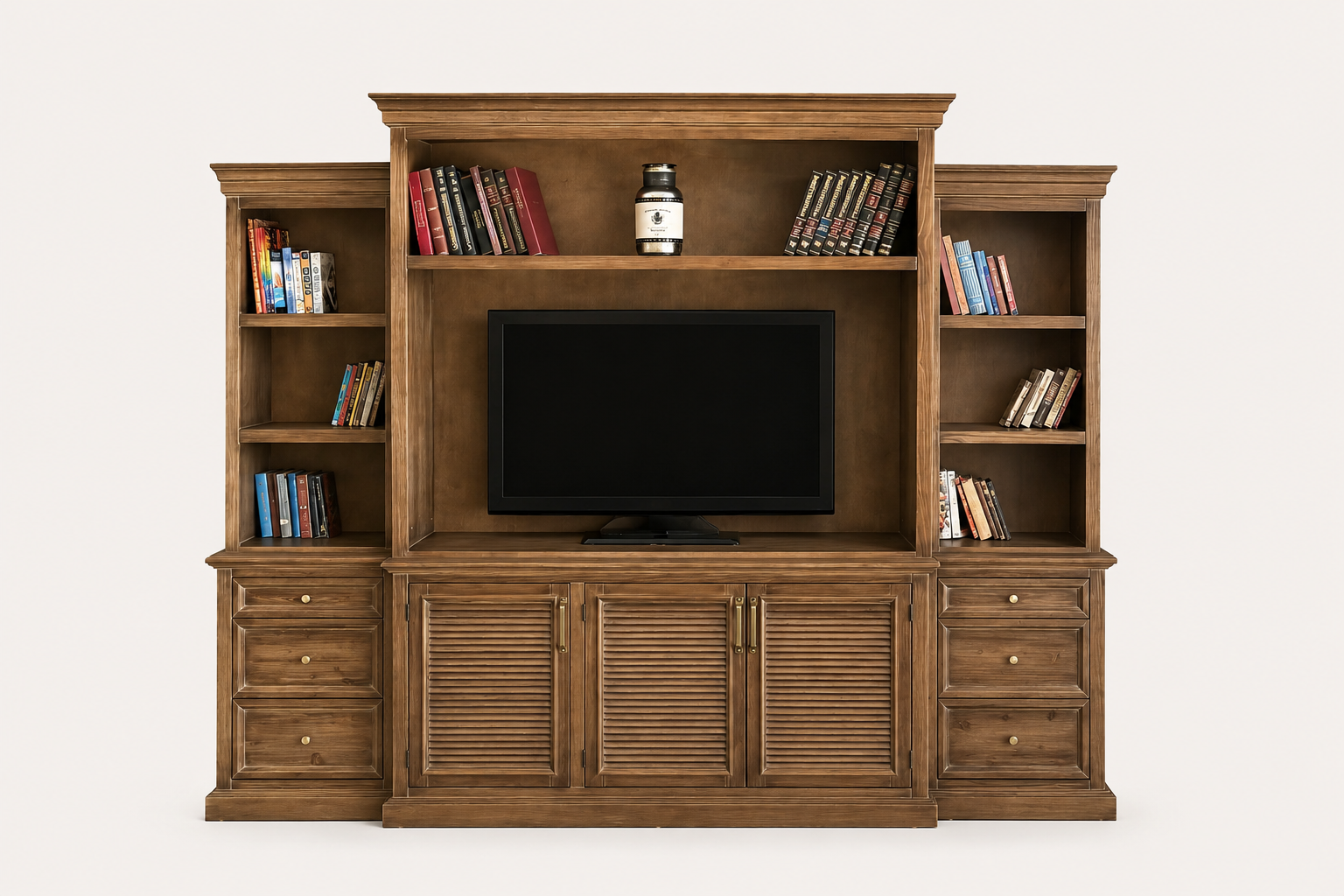
Bookcase dimensions depend on your books, your wall and your ceiling. For most books, a shelf depth of 25–30 cm and shelf spacing of 25–33 cm are enough; A4 binders and large albums need 31–35 cm of depth and about 35 cm between shelves. Tall, floor-standing bookcases are usually 180–220 cm high. Width is set by the net wall measurement left after you subtract allowances for windows, outlets and trim.
Bookcase dimensions and materials in İmhotep models
The five İmhotep models with “Bookcase” in their name range from 108 cm (Academy) to 280 cm (Lizz) in width and from 220 to 255 cm in height; the three with a listed depth are 48 to 70 cm deep. The figures in the table come from our product pages and are given in centimeters, as width × depth × height. All five models are on our bookcase models page.
| Model | Width | Depth | Height |
|---|---|---|---|
| Lizz Bookcase | 280 cm | — | 230 cm |
| Oscar Bookcase | 275 cm | 70 cm | 255 cm |
| Louis Bookcase (Without Fireplace) | 270 cm | — | 240 cm |
| Lükens Bookcase | 220 cm | 50 cm | 220 cm |
| Academy Bookcase | 108 cm | 48 cm | 220 cm |
Of the three models with a listed depth, Lükens and Academy are 48–50 cm deep, while the Oscar Bookcase, at 70 cm, is by far the deepest. Use this figure to work out how much walkway will be left in front of the bookcase. In furniture specs, the listed depth is usually the outside measurement at the deepest point of the case; on models with lower cabinets or a crown, the inside depth of the upper shelves can be less. Before you order, ask about the inside shelf depth, and about the depth of the Lizz and Louis models.
Materials can vary from model to model, too. On the Academy Bookcase, for example, the crown (the cap at the very top of the bookcase) and the middle ledge (the board that separates the lower and upper sections) are spruce, and the other parts are MDF. So before you buy, ask what the case, shelves and back panel are made of.
How deep should a bookcase be? Shelf spacing and shelf dimensions
A bookshelf should be at least 2–3 cm deeper than the width of the largest book you’ll put on it. For easy use, a little deeper is better; for a mixed collection, that usually works out to 25–30 cm. To find the shelf spacing, meaning the clear height between two shelves, add at least 3 cm to the height of your tallest book, or 4–7 cm of finger room so you can pull books out easily. Here are approximate bookcase shelf dimensions by type of book:
| What you’re shelving | Approximate size (width × height) | Shelf depth | Shelf spacing |
|---|---|---|---|
| Pocket-size book | 11 × 18 cm | 15–20 cm | 22–24 cm |
| Standard novel | 13.5 × 21 cm | 20–25 cm | 25–28 cm |
| Textbook, encyclopedia | 20 × 28 cm | 25 cm | 31–33 cm |
| A4 binder | 28.5 × 32 cm | 31–33 cm | 35 cm |
| Album, art book | 30 cm and up | 32–35 cm | 35 cm and up; can also be laid flat |
When a shelf is too deep, books get pushed to the back of the shelf or shelved two rows deep, and over time the back row disappears from view. An inside shelf depth of 40 cm or more is needed for objects and boxes rather than books; on library-style models, that depth mostly comes from the closed cabinet below.
The span of a shelf between two uprights (the vertical side pieces that carry the shelves) matters too: the longer the span, the more a loaded shelf can sag in the middle. How long the span can be depends on the shelf’s thickness and material; with thin panel shelves, bays are usually kept 60–90 cm wide. For wide bays where you’ll shelve heavy encyclopedias or albums, ask about shelf thickness and material.
Bookcase width and height: fitting your wall and ceiling
Base a bookcase’s width on the net width of your wall, and its height on your ceiling and how high you can comfortably reach. To find the net measurement, subtract allowances for trim, outlets, radiators and windows from the width of the wall. Measure the wall in three places (at the floor, at mid-height and near the top); walls aren’t always parallel or plumb, so go by the smallest figure. Leave 1–2 cm of clearance on each side so the bookcase can be set in place.
Bookcase size standards vary by manufacturer; ready-made modules are usually 40–100 cm wide, and wider walls are filled with several modules or a single wide piece. If the bookcase goes in a corner, also allow for the swing of any door or window on the adjacent wall.
A bookcase and a TV unit can also share a wall. For balancing the screen and the shelves, see our guide to TV unit dimensions.
For most adults, depending on their height, the highest shelf they can comfortably reach while standing is about 175–190 cm off the floor; shelves above that can be set aside for books you rarely use and for objects. Always measure the ceiling, and if there’s a cornice or crown molding, leave a few centimeters below it.
If the bookcase will be assembled lying on the floor and then tilted upright, the ceiling has to be higher than the diagonal of the case’s side: on the Oscar, which is 255 cm tall and 70 cm deep, that diagonal comes to about 264 cm. For tall and wide models, ask before ordering how the piece is delivered and assembled, and whether it will fit through your door and elevator. Anchor tall bookcases to the wall; this lowers the risk of tipping over, both in homes with children and during earthquakes.
Bookcase or library bookcase? Open, closed and glass-front sections
In everyday speech, “bookcase” and “library bookcase” are often used for the same piece of furniture; “library bookcase” mostly means a large bookcase that covers a wall and has cabinets below. That’s why library-style bookcase dimensions run larger: the lower cabinet usually brings the overall depth to around 40–50 cm.
Open shelves or doors?
Open shelves give you quick access to the books you read often and room for display, but they’re exposed to dust and direct sunlight. A section with doors protects books, files and albums, and hides clutter too. Glass doors are a middle ground: they show the books while keeping the dust out, but they reflect light and pick up fingerprints. Many library-style models combine open shelves above with a closed cabinet below.
Leave clear space in front of lower cabinets equal to the width of the door, and in front of drawers equal to the depth of the drawer. The Academy Bookcase’s doors with applied molding strips and its drawers on soft-close slides also need this clearance to open.
How to set up a study: bookcase and desk layout
In a good study, light reaches the desk from the side, the bookcase is within easy reach of where you sit, and there’s comfortable room to move behind the chair. At least 90 cm of clearance behind the desk is generally recommended so you can push the chair back and stand up. If the bookcase is behind the desk, measure this distance from the front of the bookcase; if the bookcase has lower doors or drawers, add the room they need to open as well.
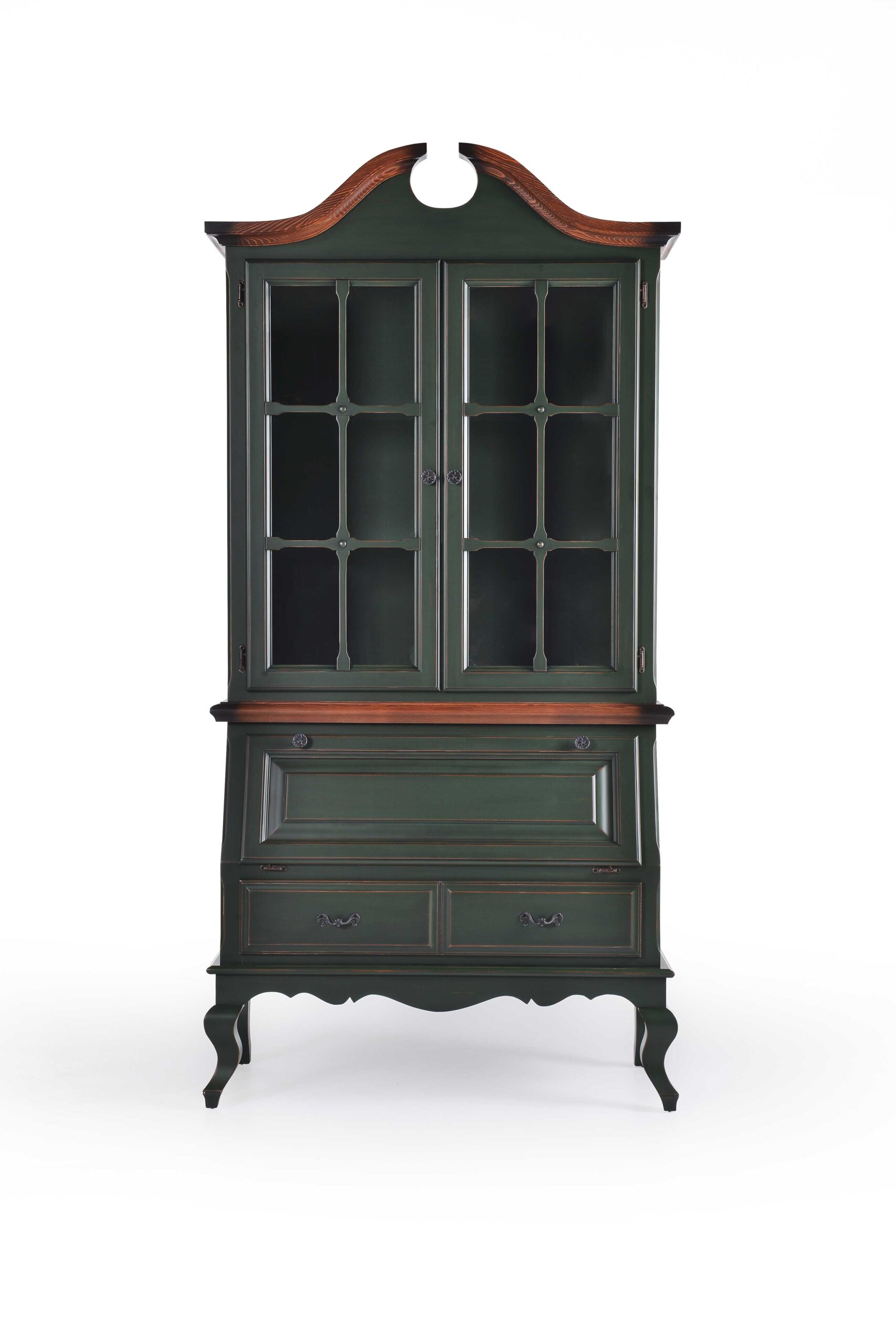
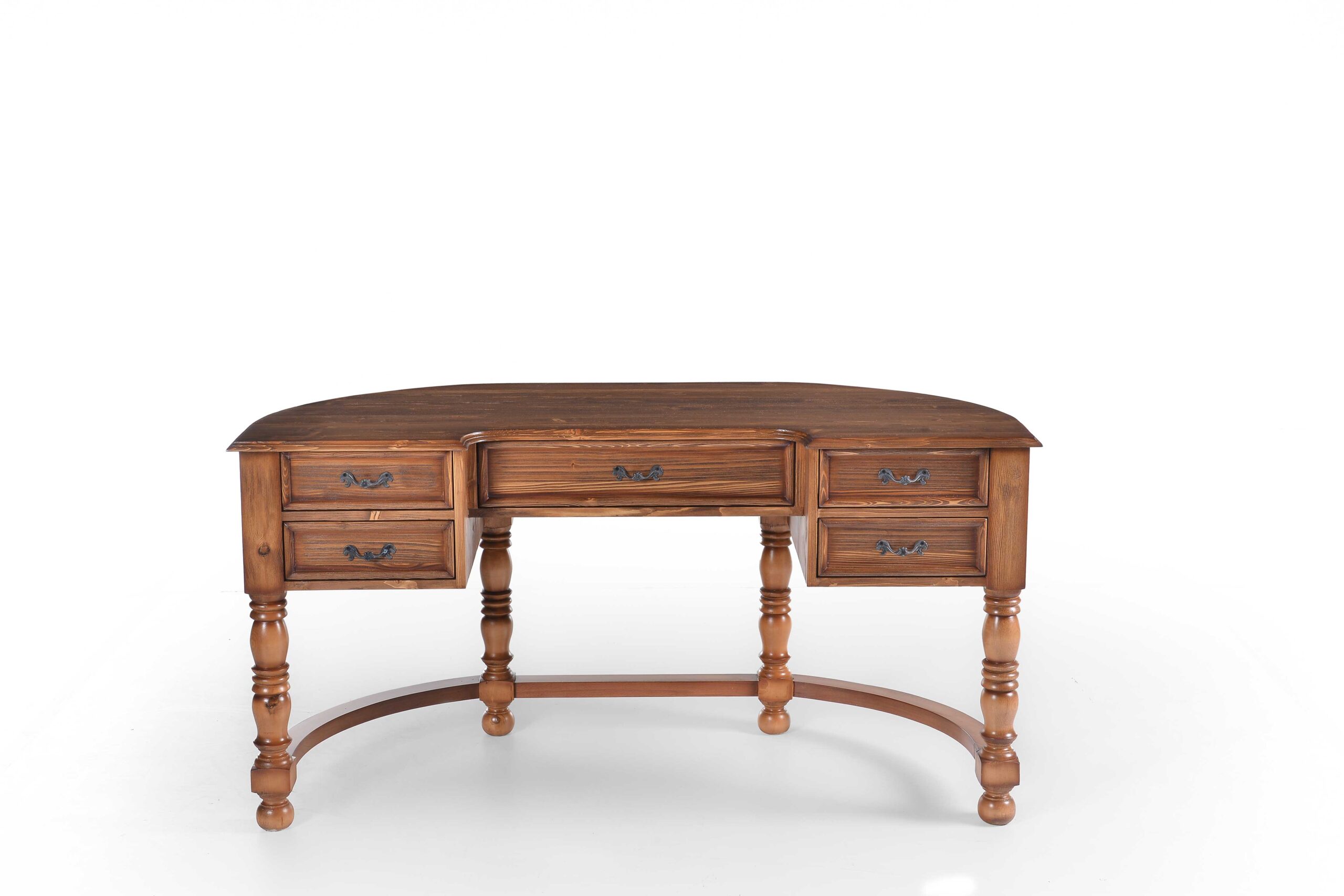
The Academy Study Desk measures 150 × 65 × 78 cm; it’s made of kiln-dried spruce and has turned legs, four small drawers and one large drawer. Set side by side, the desk and the Academy Bookcase need at least 258 cm of net wall width (150 + 108 cm); with the clearance you leave on both sides and between them, about 265 cm gives a comfortable fit. To see desks, chairs and bookcases together, browse our study furniture page.
A quick checklist for choosing a bookcase
Answer these four questions before you settle on bookcase dimensions; the ideal bookcase dimensions come from your answers, not from a single standard:
- How big is your largest book? Choose the shelf depth and spacing to match.
- What’s the net width of the wall? Subtract allowances for outlets, radiators and windows.
- How high is the ceiling? Allow for any cornice and for the case’s diagonal as it’s raised upright during assembly.
- How much clear space is left in front? Account for doors, drawers and a walkway.
If you’d like to see our bookcases in person, you can call +90 312 351 03 32 before visiting our showroom (Karacakaya Cad. No:141/A, Siteler, Ankara) to check whether the model you’re interested in is on display.
Frequently asked questions
How deep should a bookcase be?
For books alone, a shelf depth of 25–30 cm suits most collections; for a bookcase filled mostly with novels, 20–25 cm also works. A4 binders and large albums need 31–35 cm. On library-style models with lower cabinets, the overall depth is usually 40–50 cm. Across İmhotep’s three bookcases with a listed depth, the outside depth ranges from 48 to 70 cm.
How do you choose bookcase dimensions?
Three things set the dimensions: your books, your wall and your ceiling. Shelf depth should be at least 2–3 cm more than the width of your largest book, and shelf spacing at least 3 cm more than the height of your tallest one. Width follows the net wall measurement after allowances for outlets and windows; height follows the ceiling and the comfortable standing reach of about 175–190 cm.
How far apart should bookcase shelves be?
Shelf spacing of 25–28 cm is enough for standard-size novels, 31–33 cm for textbooks and encyclopedias, and about 35 cm for A4 binders. Add at least 3 cm to the height of your tallest book, or 4–7 cm so you can pull books out easily. Laying large albums and art books flat makes better use of the space than increasing the shelf spacing.
What’s the difference between a bookcase and a library bookcase?
In everyday speech the two often describe the same piece of furniture. “Bookcase” is the general name for a shelved cabinet that holds books. A library is usually a book room or an institution, though in Turkish the dictionary also defines the word for library simply as a book cabinet or bookcase. In furniture, “library bookcase” mostly refers to a large, wall-filling bookcase with cabinets below.
Should a bookcase have doors?
Open shelves are practical for books you read often and objects you want to display. For books, files and albums that need protection from dust, direct sun and small children, a section with doors is the better choice. Glass doors are a middle ground: they show what’s inside and keep the dust out. Remember to leave clear space in front of the doors equal to the width of each door.
Which room should a bookcase go in?
Bookcases mostly go in the study and the living room; the family room, a teen’s room, a hallway and the bedroom are good spots too. What matters is that the wall is dry, that the bookcase doesn’t stand right in front of a sunny window or a radiator, and that there’s a comfortable walkway in front of it. In narrow hallways, shallow models 25–30 cm deep fit more easily.